
Is unequal investment caused by unfair choices, or by unequal conditions? That’s the question at the heart of GIPC’s new Investment Opportunities Mapping Project (IOMP), a promising initiative designed to catalog viable projects across all 261 districts of Ghana. The idea is simple enough: build a database, launch a digital platform, promote clusters like the Volta Economic Corridor and the Kumasi Tech Park, and create a fairer investment spread. But real transformation demands we look past this. If Ghana’s investment pattern is skewed, is it because the state keeps choosing winners unfairly, or because some districts are simply unprepared?
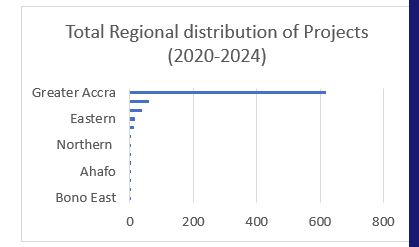
Data: GIPC Quarterly Investment Report 2020 -2024
Fair Distribution assumes the government and GIPC have the power and duty to intentionally steer capital into overlooked areas. Under this model, unequal investment is a matter of biased choices, and the solution is simple: spread projects better, give every region a chance, and correct for past neglect. Infrastructure Readiness, however, points to a deeper problem. Even if every district is listed in the database, will investors go where roads are impassable, electricity is unreliable, and the water supply is erratic? What happens when regions have no local technical partners, or when land ownership is contested? In this case, underinvestment isn’t about preference; it’s about practicality.
Many regions have not equally benefited from investments, especially those far from the south. But even when included in policy documents or investment brochures, some areas remain structurally underprepared. The IOMP is trying to change that narrative by identifying and promoting opportunities district by district. Still, it’s unclear how much of the enabling work; roads, power, finance, land, skills, is actually in place. The online platform being developed is a step forward. But if it merely lists attractive-sounding projects without grappling with the conditions on the ground, it risks becoming a catalogue of potential that never gets unlocked.
The question we should be asking is whether GIPC is doing enough to support the actual development of these opportunities, or is it just listing them? Are investors being incentivized to take risks in the hard-to-reach but high-need regions? Does decentralization here mean just passing responsibility to MMDAs, or giving them the tools to deliver?
If the IOMP is to succeed beyond the mapping, then the following must be clear:
Bankability support. Districts need help not just to identify projects but to package and pitch them, backed by solid numbers and risk assessments.
Incentive matching. Regions that are less “ready” need more than exposure, they need targeted incentives, blended finance, and risk guarantees to pull in capital.
If we truly want balanced development, we must treat unequal regions unequally, that is, give more support to the places that need it most. GIPC’s mapping project is a good beginning, but it won’t fix investment gaps unless we pair it with deliberate infrastructure choices, targeted incentives, and active matchmaking. Mapping is the easy part. The real work lies in enabling what’s been mapped.
NEWS TRENDS
- Govt banks on Investment Mapping Project to decentralise FDI flows – Citinews.
- GIPC launches Investment Opportunities Mapping Project – MyJoy News.
Credit- IMANI’s Criticality Analysis of Governance and Economic Issues 7 – 11 July, 2025.


