Reflections from the South African Peering Forum on what AI traffic, fragmented peering, and strained backhaul mean for Ghana’s 5G moment.
By: Sitsofe Mensah, Solutionist and Technology Associate with IMANIAfrica
Last week in Cape Town, I sat in a room full of African network engineers at the South African Peering Forum. On stage, Mark Tinka of TransmissionCo delivered a warning that followed me all the way back to Accra. His thesis was disarmingly simple.
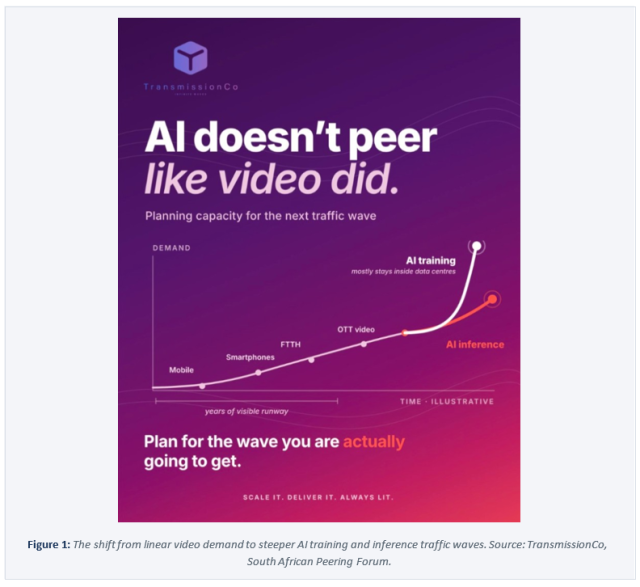
Artificial intelligence does not behave like video on the internet.
For more than a decade, video streaming gave African telecom networks an easy runway. Demand rose in a steady, predictable line. Engineers could plan upgrades almost by looking in the rear-view mirror.
When you open TikTok or YouTube in Tema or Kumasi, the internet plays a quiet trick in your favour. A local server nearby stores popular clips, and your phone downloads a few seconds ahead. Even if the signal stumbles briefly, the video plays on without complaint.
AI strips away that cushion. Training huge models sends massive, sudden bursts of data racing between data centres. The part that actually touches your phone is called inference, which is the live moment an AI listens, thinks, and responds.
Inference traffic is constant, interactive, and fiercely allergic to delay. Your phone cannot pre-load an answer before you ask the question. Cisco estimates this wave could add 63 per cent to network traffic growth, and Mark joked that whoever picked that figure probably aimed too low.
This future is no longer sitting in Silicon Valley. Cassava Technologies has already switched on
Africa’s first NVIDIA-powered AI factory in South Africa. Akamai, a content delivery network built on local peering, signed an $11.6 billion AI infrastructure deal with Anthropic weeks ago.
I lead caching and peering programmes for Google across Africa. That work keeps me in weekly
conversations with mobile operators, exchange managers, and fibre carriers across the continent. I share this reflection in a personal capacity to help inform practical policy and smart execution here at home.
Three Lorry Stations, No Connecting Road
Mark made one point that should keep Ghanaian telecom executives awake at night. Once AI
inference lands locally, it stops being an international cable problem. It becomes a local ISP, metro fibre, backhaul, and Internet Exchange Point problem.
Think of an Internet Exchange Point as a central lorry station for data. Instead of sending a local message all the way to London and back, Ghanaian networks meet at the station and swap traffic directly.
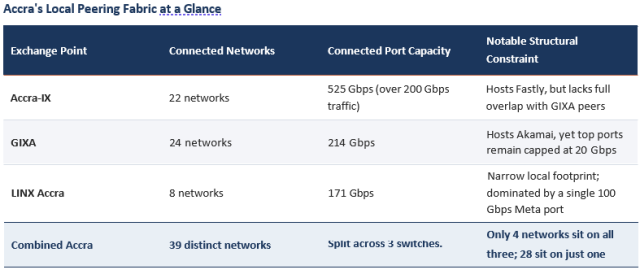
Accra does not run one deep, unified lorry station. We run three separate exchanges, namely GIXA, Accra-IX, and LINX Accra. Across all three, there are 39 distinct networks present in Accra.
Only four of those networks sit on all three exchanges. Twenty-eight sit on just one.
Look closely at what that split produces. Accra-IX recently passed 200 Gbps of traffic across 525
Gbps of connected ports. GIXA hosts 24 networks on 214 Gbps of capacity, yet its biggest ports still top out at 20 Gbps. LINX Accra connects 8 networks.
Akamai peers on GIXA alone. Fastly sits on Accra-IX alone. Two Ghanaian networks that both assume they are exchanging traffic locally often do not share a single switch.
Their customers’ data quietly boards an undersea cable, visits Europe, and loops back into Accra.
Compare that with Johannesburg’s NAPAfrica passing 5 terabits per second, or Lagos upgrading to 400-gigabit exchange ports. Our fragmented setup is hardly an inviting runway for real-time AI.
The 5G Promise and the 4G Majority.
Just this week in Parliament, the Minister of Communication, Digital Technology and Innovations confirmed that Ghana raised $240 million selling 5G spectrum across the 700 MHz, 2.3 GHz, and 3 GHz bands. MTN Ghana and Telecel Ghana now hold licences. Citizens have been promised live 5G signals between December 2026 and early 2027.
Faster networks are welcome news. Yet 5G only upgrades the wireless hop between your handset and the nearest mast.

Even today, many 3G and 4G towers across Ghana cannot sustain the real speeds those technologies already promise. Roadside trenches slice metro fibre with frustrating regularity. Chained microwave links choke during evening peaks.
Now factor in the everyday Ghanaian consumer. National Communications Authority figures through the second quarter of 2026 show 30.5 million mobile internet subscriptions against fewer than 295,000 fixed fibre lines. Almost the entire country lives on mobile data.
Most households will not buy a 5G smartphone next year. Decent 5G handsets remain expensive for ordinary budgets. Students, market traders, drivers, and small offices will stay on 3G and 4G for a long time to come.
That reality carries three quiet consequences.
First, every cedi spent lighting up flagship 5G clusters in East Legon or Airport City competes with upgrades for congested 4G masts in Ashaiman, Kasoa, or Suame. Operators already face heavy
spectrum bills and tight margins. Legacy 4G layers risk feeling slower right as the nation celebrates a faster badge.
Second, AI fails differently on a tired 4G connection. Social video hides poor backhaul behind a buffer. Live AI voice tools, coding assistants, and real-time translation apps simply freeze, drop calls, and drain phone batteries through endless retries.
Third, Ghana risks building a quiet two-speed internet. A thin slice of urban users on fixed fibre, satellite, or 5G will treat AI as an instant utility. Millions on overloaded 4G towers will stare at a blinking cursor waiting for a reply.
Fixing the Plumbing Before the Flood
Mark ended his Cape Town presentation with four sharp questions for optical and backhaul suppliers.
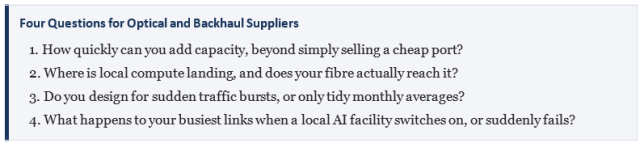
Those sound like purely technical questions. In Ghana, the answers rest just as heavily with policymakers and regulators.
The country is currently reviewing the proposed Electronic Communications Bill to replace the 2008 Act. That review gives Parliament, the Ministry of Communication, Digital Technology and Innovations, and the NCA a rare window to fix the foundation.
Spectrum auctions should never be treated as the finish line. Regulatory frameworks need to reward deep tower fibreisation, resilient metro rings, and strict quality of service on everyday 4G networks. Press releases about 5G mean very little if 4G crawls.
Policy must also encourage open, frictionless peering across Accra’s exchanges so local traffic stays
home without detours. Just as urgently, road agencies and local assemblies must protect buried fibre from routine excavation and make duct sharing simpler and cheaper.
Operators, too, face an honest reckoning. Buying cheap international capacity while starving local backhaul may flatter a quarterly budget. It will not survive the moment interactive AI traffic hits the evening peak.
We are right to look forward to seeing 5G signals light up across Ghana in the coming months. Still, before we celebrate a new icon at the top corner of our phone screens, one question deserves a straight answer.
Are we widening the roads so the whole country can move faster, or merely hanging a brighter signboard above the same old traffic jam?

A Shiny New Tap on an Old Pipe
Reflections from the South African Peering Forum on what AI traffic, fragmented peering, and strained backhaul mean for Ghana’s 5G moment.
By: Sitsofe Mensah, Solutionist and Technology Associate with IMANIAfrica
Last week in Cape Town, I sat in a room full of African network engineers at the South African Peering Forum. On stage, Mark Tinka of TransmissionCo delivered a warning that followed me all the way back to Accra. His thesis was disarmingly simple.
Artificial intelligence does not behave like video on the internet.
For more than a decade, video streaming gave African telecom networks an easy runway. Demand rose in a steady, predictable line. Engineers could plan upgrades almost by looking in the rear-view mirror.
When you open TikTok or YouTube in Tema or Kumasi, the internet plays a quiet trick in your favour. A local server nearby stores popular clips, and your phone downloads a few seconds ahead. Even if the signal stumbles briefly, the video plays on without complaint.
AI strips away that cushion. Training huge models sends massive, sudden bursts of data racing between data centres. The part that actually touches your phone is called inference, which is the live moment an AI listens, thinks, and responds.
Inference traffic is constant, interactive, and fiercely allergic to delay. Your phone cannot pre-load an answer before you ask the question. Cisco estimates this wave could add 63 per cent to network traffic growth, and Mark joked that whoever picked that figure probably aimed too low.
This future is no longer sitting in Silicon Valley. Cassava Technologies has already switched on
Africa’s first NVIDIA-powered AI factory in South Africa. Akamai, a content delivery network built on local peering, signed an $11.6 billion AI infrastructure deal with Anthropic weeks ago.
I lead caching and peering programmes for Google across Africa. That work keeps me in weekly
conversations with mobile operators, exchange managers, and fibre carriers across the continent. I share this reflection in a personal capacity to help inform practical policy and smart execution here at home.
Three Lorry Stations, No Connecting Road
Mark made one point that should keep Ghanaian telecom executives awake at night. Once AI
inference lands locally, it stops being an international cable problem. It becomes a local ISP, metro fibre, backhaul, and Internet Exchange Point problem.
Think of an Internet Exchange Point as a central lorry station for data. Instead of sending a local message all the way to London and back, Ghanaian networks meet at the station and swap traffic directly.
Accra does not run one deep, unified lorry station. We run three separate exchanges, namely GIXA, Accra-IX, and LINX Accra. Across all three, there are 39 distinct networks present in Accra.
Only four of those networks sit on all three exchanges. Twenty-eight sit on just one.
Look closely at what that split produces. Accra-IX recently passed 200 Gbps of traffic across 525
Gbps of connected ports. GIXA hosts 24 networks on 214 Gbps of capacity, yet its biggest ports still top out at 20 Gbps. LINX Accra connects 8 networks.
Akamai peers on GIXA alone. Fastly sits on Accra-IX alone. Two Ghanaian networks that both assume they are exchanging traffic locally often do not share a single switch.
Their customers’ data quietly boards an undersea cable, visits Europe, and loops back into Accra.
Compare that with Johannesburg’s NAPAfrica passing 5 terabits per second, or Lagos upgrading to 400-gigabit exchange ports. Our fragmented setup is hardly an inviting runway for real-time AI.
The 5G Promise and the 4G Majority.
Just this week in Parliament, the Minister of Communication, Digital Technology and Innovations confirmed that Ghana raised $240 million selling 5G spectrum across the 700 MHz, 2.3 GHz, and 3 GHz bands. MTN Ghana and Telecel Ghana now hold licences. Citizens have been promised live 5G signals between December 2026 and early 2027.
Faster networks are welcome news. Yet 5G only upgrades the wireless hop between your handset and the nearest mast.
Even today, many 3G and 4G towers across Ghana cannot sustain the real speeds those technologies already promise. Roadside trenches slice metro fibre with frustrating regularity. Chained microwave links choke during evening peaks.
Now factor in the everyday Ghanaian consumer. National Communications Authority figures through the second quarter of 2026 show 30.5 million mobile internet subscriptions against fewer than 295,000 fixed fibre lines. Almost the entire country lives on mobile data.
Most households will not buy a 5G smartphone next year. Decent 5G handsets remain expensive for ordinary budgets. Students, market traders, drivers, and small offices will stay on 3G and 4G for a long time to come.
That reality carries three quiet consequences.
First, every cedi spent lighting up flagship 5G clusters in East Legon or Airport City competes with upgrades for congested 4G masts in Ashaiman, Kasoa, or Suame. Operators already face heavy
spectrum bills and tight margins. Legacy 4G layers risk feeling slower right as the nation celebrates a faster badge.
Second, AI fails differently on a tired 4G connection. Social video hides poor backhaul behind a buffer. Live AI voice tools, coding assistants, and real-time translation apps simply freeze, drop calls, and drain phone batteries through endless retries.
Third, Ghana risks building a quiet two-speed internet. A thin slice of urban users on fixed fibre, satellite, or 5G will treat AI as an instant utility. Millions on overloaded 4G towers will stare at a blinking cursor waiting for a reply.
Fixing the Plumbing Before the Flood
Mark ended his Cape Town presentation with four sharp questions for optical and backhaul suppliers.
Those sound like purely technical questions. In Ghana, the answers rest just as heavily with policymakers and regulators.
The country is currently reviewing the proposed Electronic Communications Bill to replace the 2008 Act. That review gives Parliament, the Ministry of Communication, Digital Technology and Innovations, and the NCA a rare window to fix the foundation.
Spectrum auctions should never be treated as the finish line. Regulatory frameworks need to reward deep tower fibreisation, resilient metro rings, and strict quality of service on everyday 4G networks. Press releases about 5G mean very little if 4G crawls.
Policy must also encourage open, frictionless peering across Accra’s exchanges so local traffic stays
home without detours. Just as urgently, road agencies and local assemblies must protect buried fibre from routine excavation and make duct sharing simpler and cheaper.
Operators, too, face an honest reckoning. Buying cheap international capacity while starving local backhaul may flatter a quarterly budget. It will not survive the moment interactive AI traffic hits the evening peak.
We are right to look forward to seeing 5G signals light up across Ghana in the coming months. Still, before we celebrate a new icon at the top corner of our phone screens, one question deserves a straight answer.
Are we widening the roads so the whole country can move faster, or merely hanging a brighter signboard above the same old traffic jam?
Related Posts
Twice Billed for Dirty State Databases
Ghana’s Waterways Must No Longer Be Corridors of Preventable Death
More News/Articles
A Shiny New Tap on an Old Pipe
Twice Billed for Dirty State Databases
Ghana’s Waterways Must No Longer Be Corridors of Preventable Death
Subscribe to our newsletter