By: Casely Ato Coleman, Senior Fellow, IMANI Center for Policy Education
Section 1.0 – Introduction
Education has long been recognized as the engine of social and economic transformation in Ghana. At the apex of the education system lies higher education, expected to produce knowledge to generate the skilled workforce, research, and innovation that can propel the country toward transformational growth. Management centred universities produce knowledge to train management graduates who are supported to grow to become management professionals. In the same vein in recent times, academics, policy makers and industry have expressed concerns about the gap between academia and industry and the resultant challenges graduates face when they enter the labour market.
In this note and based on the author’s lived experience as a global HR leader, HR lecturer and HR researcher for over 30years as well as a recent analysis of recruitment and selection consulting work done for the past 18months, I examine some of the challenges and propose potential solutions to address that gap which is proving to be a “gordian knot” in university education and Ghana’s labour market.
Section 2.0 – Epistemology of Knowledge & Management Education
The inspiration behind this note is grounded on the philosophical perspectives of knowledge. A review of the literature on knowledge management indicates varying perspectives with respect to the philosophical definition on knowledge(Dueck,2001, Martensson, 2000, Fahey &Prusak, 1998). Three varying perspectives have been identified in the literature: (1) knowledge as an object (2) knowledge as residing in individual minds and (3) knowledge as being constructed socially. The definition of knowledge as an object posits that knowledge exists outside of people. This definition is associated with engineering(Hendriks 2001). It limits knowledge to information ie data organized and structure in a context relevant to the user (Wiig 1997). On the other hand, the philosophical perspective of knowledge as residing in individual minds, defines knowledge as residing in the minds of individual employees of the organization who apply cognitive processes to transform information into knowledge (Nonaka 1994). Knowledge is created through knowledge conversion, focusing on a dialogue between tacit and explicit knowledge. Finally, the social perspective considers knowledge to be socially constructed as groups of individuals engage in talk and activity around shared tasks or problems (Merriam & Caffarella, 1999).
In line with the three philosophical perspectives of knowledge, this paper posits that:
- the combination of theorists, practitioners and practitioner-scholars in management education, offers an integrated knowledge management architecture that adds immense value to the quality and outcomes of management university education and professional development
- that integration produces axiomatic knowledge that explains the “why” of a discipline, dictionary knowledge that explains the “what” of a discipline, directory knowledge that explains the “how” of a discipline and recipe knowledge that explains the “should” of a discipline.
Having laid the background and philosophical framework of the note, we will now discuss a summary overview of the research I did recently on recruitment and selection.
3.0 Data
Survey of 15 hiring and selection processes I have conducted for the past 24 months (2024-2026) for local and international organizations who wanted to hire Ghanaians for entry level and mid-level HR roles. Overall 45% of the organizations were either NGOs or social enterprises and 55% were “for profit”. 65% of the companies were local Ghanaian owned and 35% were international organisations with their Headquarters outside Ghana.
Type of assessment
In-tray exercises, cases study analysis, written tests and panel interviews.
Areas probed
- For Mid -level ( at least 5years and above) – HR strategy, organizational design, change management, HR delivery models, succession planning, reward systems
- For entry level (0-18months) – basic HR technical approaches on talent acquisition cycles, learning and development, employee wellbeing, employee engagement, HRIS etc
Based on the outcomes of the hiring processes, it was obvious that over 75% of shortlisted applicants who attended the final processes, struggled to apply the concepts they had learned in the classes, or had never heard of contemporary HR technical approaches or project models. There were many instances where applicants struggled with in-tray practice assessments, could not write concise papers or present ideas coherently that can guide Management decision making. I did further background checks on the universities these graduates attended and observed that many of their lecturers had not had practical/industry experience in their areas of specializations. Interestingly the small sample of applicants who came out strongly attended universities or institutions where their lecturers had previous stints in industry or alternatively they invited practitioners to teach particular topics to reinforce learning.
My conclusion is that it is time for Ghana to institutionalize Professor Practice as one of the means to bridge the gap between industry and academia.
4.0 Scope and Coverage of Professor of Practice
4.1 Professor of Practice –Examples of Best Practices
As a way to connect industry to academia, some universities, globally-speaking, appoint Professors of Practice. According to Durham University in the U.K., Professors of Practice/Professors in Practice “are experienced professionals across a wide variety of disciplines and sectors, who share their skills and knowledge directly with students, bringing public distinction and practical insights to the classroom. The initiative provides the opportunity for the University’s faculty to directly connect with business practice and public policy, enabling their research to have an actionable, positive impact on society.”
https://www.durham.ac.uk/business/our-people/professors-in-practice/
Cardiff University, also in the U.K., states as follows: “A Professor of Practice is a specialist role within the University developed to facilitate the employment of exceptional individuals able to provide Schools/Colleges with knowledge and leadership from their current and extensive experience within the relevant professional discipline within industry and business. Such roles are designed to facilitate greater integration of industrial/business leaders (including the professional practice subject area) into education programmes offered by the University.” https://www.cardiff.ac.uk/__data/assets/pdf_file/0009/1195776/Professor-of-Practice-City-Futures.pdf
In the U.S., the University of Kansas declares: ’Professors of the Practice’ are non-tenure track faculty who possess the expertise and achievements to provide professional instruction in a manner that brings distinction to the appointing School/College and the University.” https://services.ku.edu/TDClient/818/Portal/KB/ArticleDet?ID=21329
The University of California, Santa Barbara, notes that “appointees provide faculty, undergraduate students, and graduate students with an understanding of the practical applications of a particular field of study. Professors of Practice teach courses, advise students, and collaborate in areas directly related to their expertise and experience.” While specifying that there are three categories of such appointees – “Assistant Professor of Practice”, “Associate Professor of Practice” and “Professor of Practice” – Indeed.com states, as follows, with respect to supplementary criteria for appointment: “Other criteria may include professional awards and honors, experience in offering consultancy to government organizations regarding their specializations and leadership positions in highly respective professional guilds.” https://ap.ucsb.edu/policies.and.procedures/red.binder/sections/%5B5_20%5D%20Professor%20of%20Practice.pdf
Regrettably in Ghana this approach that connects industry to practice is not properly institutionalized within our Tertiary Education Architecture. There seems to be an apprehension concerning the use of the title professor of practice even though there is an acceptance that they offer a knowledge management solution towards addressing the gap between industry and practice. Some universities have tried to navigate that bureaucratic obstacle by calling them ‘industry fellows” or “Practitioners in residence” etc. It is time to openly have a conversation on how to integrate professor of practice into Ghana’s development agenda supported by the right organizational framework and quality assurance standards.
4.2 Scope, Coverage and Purpose
A Professor of Practice is a faculty role for someone hired primarily because of their deep professional experience, not because of a traditional academic research track. Universities create professor of practice roles to bridge theory and practice and also facilitate the availability of current industry methods, case studies, and networks students wouldn’t get from career academics. It is very common in business, politics, law, journalism, public policy, engineering, HR, Finance, Marketing, Management and arts. The intended outcome for bringing in professor of practice is to enable students to learn how things actually work in the field to ease transition from academia to the labour market. Professors of practice also enhance credibility with students/employers when for example they see a former CFO teaching finance, or a former NGO Country Director teaching development management. This adds legitimacy and practicality to the program they are pursing. In addition, it creates flexibility and enables universities to hire leaders who don’t have PhDs but have led companies, ministries, or major projects.
4.3 What they actually do?
They teach courses grounded in applied work – e.g. “HR Strategy” taught by someone who was HR Director, mentor students on careers, internships, capstone projects. They also facilitate industry partnerships by enabling guest speakers, site visits, live client projects and provide consultancy to the university on curriculum relevance. They sometimes publish but it’s usually applied articles, not theoretical research
Examples of professor of practice are a retired diplomat becomes professor of practice in International Relations, a former or current Chief Technology Officer (CTO) becomes a professor of practice in Information System and Technology, a retired and accomplished leader of parliament becomes a professor of practice in the study of parliamentary democratic governance etc.
4.4 Difference between Regular Professor and Professor of Practice
| Regular Professor | Professor of Practice |
| Hired for Research + teaching + publishing | Hired for Industry/professional expertise + teaching
|
| Qualifications – PhD + peer-reviewed publications | Qualification: Senior-level career experience, often 20+ years
|
| Tenure : Usually eligible | Usually non-tenure track, fixed-term or renewable contract
|
| Main job: Produce new knowledge via research | Translate real-world practice into the classroom
|
| Promotion: Based on research output, grants, citations | Promotion: Based on teaching, impact, professional standing
|
It must be noted that there are also professors/academics who have had practical industry experience before joining academia and one can always see the difference in the positive reviews they receive from their students.
4.5 Practitioner –Scholar
There is also another type of practitioner- scholarship that connects theory to practice and research. Practitioner scholars are individuals who have distinguished themselves in practice and have converted their knowledge into teaching, thought leadership and peer reviewed publications that brings additional insights that connect theory, research and practice. Practitioner scholars are a hybrid of pure academic and pure industry experts. The term practitioner scholar expresses an ideal of professional excellence grounded in theory, practice and research, informed by experiential first-hand practical and theoretical knowledge, and motivated by personal values, and ethical conduct. Practitioner scholars are committed to learning new ways of being effective, and to conceptualizing their work in relation to broader organizational, community, political, and cultural contexts. Practitioner scholars explicitly reflect on and assess the impact of their work through research that produce practice frameworks or technical approaches that convert theory to practice via research. Their professional activities and the knowledge they develop are based on collaborative and relational learning through active exchange within communities of practice and scholarship that solves problems. Savickas (2024).
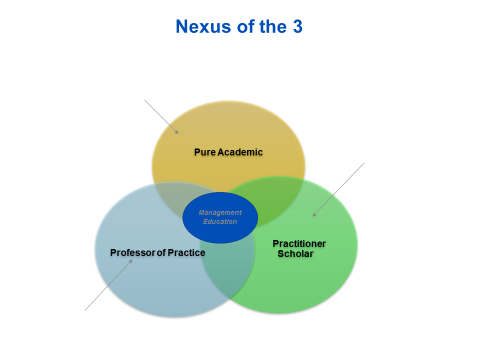
It is my view that universities can integrate academics, professors of practice and practitioner scholars into the design and delivery of degree programmes. This will open three career pathways for graduates into academia, industry and practitioner scholarship. Professors of practice and practitioner scholars can contribute to research publications that require a practitioner scholar’s lens.
Figure 1
Figure 1 summarizes the integration of the 3 Pathways of Knowledge for Management Education discussed earlier in Section 4.
5.0 – Recommendations & Next Steps
This paper has used a limited data analysis and a review of the practices of some renowned universities to discuss the importance of the concept of professor of practice and practitioner scholarship as models to bring the gap between academia and industry in management education and potentially other fields of endeavors. If this model is institutionalized, it can become a ‘change agent’ or ‘positive disruptor” in Ghana’s tertiary educational system by institutionalizing professor of practice and practitioner scholars to strengthen management education to bridge the gap between academia and industry.
I propose five main pillars to effect this change:
- Values and behaviors – a focus on integrating values and behaviors based theory and practice as key pillars in management education and attracting individuals who have a proven passion and accomplishments to bring their industry expertise to nurture and grow the next generation of ethically driven leaders that Ghana needs.
- Structure – there is a need to review GTEC its structure and approaches to integrate professor of practice and practitioner scholarship into its accreditation and credential processes and standards.
- Political will by key duty bearers eg academia, industry and government to institutionalize the model to offer a practical solution to the perennial concerns of the gap between academia and industry to enable universities graduates to get a good start when they enter the increasingly complex and shrinking labour market locally and globally.
- Quality assurance and operational excellence that will set clear quality standards on qualifications and requirements for engaging professors of practice and practitioner scholars backed by rigorous reviews of their work in line with each university’s vision, mandate and quality standards. An obvious example is to design courses with components taught by regular professor and a professor of practice, while accountability for overall quality assurance rests with the regular professor.
- Data and Technology – this will require leveraging technology and building nimble databases to capture the enormous talent pool that Ghana possesses in various disciplines and fields which will otherwise go to waste when such pool of talent and knowledge are not captured and ploughed back into management education.
Conclusion
Professor of practice and practitioner scholarship offers a clear pathway to bridge the gap between academia and industry. We have provided the philosophical and practical framework to implement the concept. It is our hope that this note will trigger a conversation to start the transformative process of formally integrating professors of practice and practitioner scholars to bridge the gap between academia and industry and thereby develop well rounded graduates to succeed in an increasingly tough local and global labour markets. It is time to stop the talk, trigger the required institutional reforms and walk the talk!
References
Cardif University – https://www.cardiff.ac.uk/__data/assets/pdf_file/0009/1195776/Professor-of-Practice-City-Futures.pdf
Durham University – https://www.durham.ac.uk/business/our-people/professors-in-practice/
Dueck,G.(2001). Views of knowledge are human views. IBM Systems Journal, 40(4). 885-888
Fahey, L., &Prusak,L(1998). The eleven deadliest sins of knowledge management. California Management Review, 40(3), 265- 276.
Hendriks,P.H.J (2001). Many rivers to cross: from ICT to knowledge management systems. Journal of Information Technology, 16,57-72
Martensson, M(2000). A critical review of knowledge management as a management tool. Journal of Knowledge management, 4(3), 204- 216.
Merriam, S.B., &Caffarella, R.S. (1999). Learning in adulthood: A comprehensive guide. San Francisco: Josey-Bass
Nonaka,I (1994). A dynamic theory of organizational knowledge creation. Organization Science, 5(1), 14-37
Savickas, Mark. (2024). Developing a scholar-practitioner model for career practice and research. Journal of the National Institute for Career Education and Counselling. 1. 3-5. 10.20856/jnicec.0101.
Wiig,K(1997). Knowledge management: where did it come from and where will it go? Journal of Expert Systems with Applications, 13(1), 1- 14.
University of California, Santa Barbara https://ap.ucsb.edu/policies.and.procedures/red.binder/sections/%5B5_20%5D%20Professor%20of%20Practice.pdf
University of Kansas –https://services.ku.edu/TDClient/818/Portal/KB/ArticleDet?ID=21329
Comment by Professor Emeritus Charles Taylor Kerchner on Mr Coleman’s Paper
 Loading...

 Reload document
 Open in new tab