Prepared by: Kay Codjoe
A chronological documentary and legal assessment of development, procurement, clinical record migration, NHIS claims, cloud hosting, data integrity and public accountability.
Editorial note and method
This report is written by Kay Codjoe as a public-interest documentary assessment. It draws on the source materials and accounts identified in the accompanying reference register. Government assertions, contractor responses, published audits, academic research and news reports are distinguished wherever the evidence permits. The report does not claim that the author interviewed witnesses, inspected production servers or audited patient-level records.
The central editorial rule is straightforward: a reported sum is not an audited loss; a reported interruption is not proof of permanent data destruction; and a contractual disagreement does not settle a constitutional question. Dates, reported values and competing explanations remain attributed to their sources. Where underlying documents have not been independently authenticated, the finding is provisional.
Executive assessment
Ghana’s digital health story did not begin with Lightwave. DHIMS1 established district-level reporting; DHIMS2 introduced national web-based public-health reporting; LHIMS pursued electronic clinical workflows; and GHIMS became the government-directed successor amid contractual disputes. In October 2026, a separate DHIMS2 hosting interruption exposed a dependency that the health system could not safely ignore.
The principal accountability questions concern reliable access to patients’ histories, lawful and recoverable NHIS claims, continuity of public-health reporting, the true location and control of sensitive data, and whether warnings about funding and hosting arrangements were acted upon. The available material supports inquiry, not a verdict of nationwide system failure or quantified financial loss.
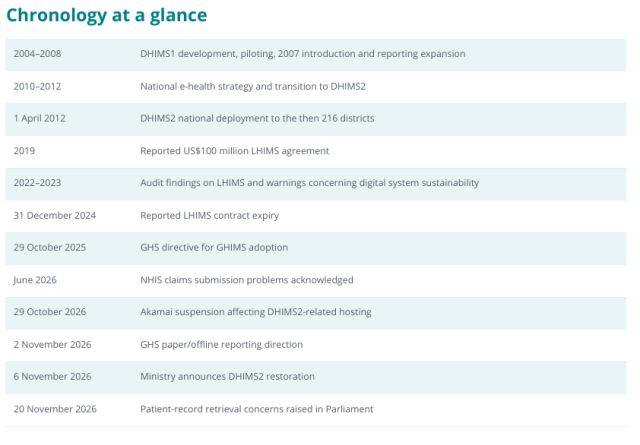
Executive findings and limits of this investigation: The development of Ghana’s digital health infrastructure predates LHIMS. The original DHIMS was introduced in 2007, while the web-based DHIMS2 was deployed nationally on 1 April 2012. The latter serves routine public-health reporting and must not be mistaken for the hospital-level LHIMS or GHIMS platforms. The reported LHIMS agreement, valued at US$100 million, became the subject of contractual, financial and technical disputes. The reported US$76.99 million paid, the 450-of-950 facility figure and the disputed equipment quantities are not substitutes for a certified valuation of delivered work. The October 2025
LHIMS-to-GHIMS transition raises a separate, current question: were historical clinical records extracted, accurately matched to patients, validated and made reliably retrievable at the point of care? No nationally certified reconciliation rate is established in the reviewed material. In June 2026, medical superintendents described difficulties submitting NHIS claims after migration. NHIA officials acknowledged the problem. The amount outstanding and the resolution rate remain unverified. On 29 October 2026, Akamai reportedly suspended ten servers supporting DHIMS2 and related systems over US$64,510.95 in unpaid hosting charges. The Ministry stated that GHIMS was not suspended and announced DHIMS2 restoration on 6 November. On 20 November 2026, the Minority Leader raised complaints from health professionals concerning access to patient records. This establishes a live parliamentary issue, not the technical cause, geographic prevalence or permanence of any data loss.
Read the full report:
 Loading...

Ghana’s Digital Health Transition: From DHIMS1 and DHIMS2 to LHIMS, GHIMS and the 2026 Hosting Crisis
Prepared by: Kay Codjoe
A chronological documentary and legal assessment of development, procurement, clinical record migration, NHIS claims, cloud hosting, data integrity and public accountability.
Editorial note and method
This report is written by Kay Codjoe as a public-interest documentary assessment. It draws on the source materials and accounts identified in the accompanying reference register. Government assertions, contractor responses, published audits, academic research and news reports are distinguished wherever the evidence permits. The report does not claim that the author interviewed witnesses, inspected production servers or audited patient-level records.
The central editorial rule is straightforward: a reported sum is not an audited loss; a reported interruption is not proof of permanent data destruction; and a contractual disagreement does not settle a constitutional question. Dates, reported values and competing explanations remain attributed to their sources. Where underlying documents have not been independently authenticated, the finding is provisional.
Executive assessment
Ghana’s digital health story did not begin with Lightwave. DHIMS1 established district-level reporting; DHIMS2 introduced national web-based public-health reporting; LHIMS pursued electronic clinical workflows; and GHIMS became the government-directed successor amid contractual disputes. In October 2026, a separate DHIMS2 hosting interruption exposed a dependency that the health system could not safely ignore.
The principal accountability questions concern reliable access to patients’ histories, lawful and recoverable NHIS claims, continuity of public-health reporting, the true location and control of sensitive data, and whether warnings about funding and hosting arrangements were acted upon. The available material supports inquiry, not a verdict of nationwide system failure or quantified financial loss.
Executive findings and limits of this investigation: The development of Ghana’s digital health infrastructure predates LHIMS. The original DHIMS was introduced in 2007, while the web-based DHIMS2 was deployed nationally on 1 April 2012. The latter serves routine public-health reporting and must not be mistaken for the hospital-level LHIMS or GHIMS platforms. The reported LHIMS agreement, valued at US$100 million, became the subject of contractual, financial and technical disputes. The reported US$76.99 million paid, the 450-of-950 facility figure and the disputed equipment quantities are not substitutes for a certified valuation of delivered work. The October 2025
LHIMS-to-GHIMS transition raises a separate, current question: were historical clinical records extracted, accurately matched to patients, validated and made reliably retrievable at the point of care? No nationally certified reconciliation rate is established in the reviewed material. In June 2026, medical superintendents described difficulties submitting NHIS claims after migration. NHIA officials acknowledged the problem. The amount outstanding and the resolution rate remain unverified. On 29 October 2026, Akamai reportedly suspended ten servers supporting DHIMS2 and related systems over US$64,510.95 in unpaid hosting charges. The Ministry stated that GHIMS was not suspended and announced DHIMS2 restoration on 6 November. On 20 November 2026, the Minority Leader raised complaints from health professionals concerning access to patient records. This establishes a live parliamentary issue, not the technical cause, geographic prevalence or permanence of any data loss.
Read the full report:
Related Posts
The AFCFTA Ring Has Fifty-Four Flags and Zero Referees
Mahama Dominates Ghana’s Political Conversation as Galamsey, Corruption and Economic Pressures Shape Public Sentiment
More News/Articles
Ghana’s Digital Health Transition: From DHIMS1 and DHIMS2 to LHIMS, GHIMS and the 2026 Hosting Crisis
The AFCFTA Ring Has Fifty-Four Flags and Zero Referees
Mahama Dominates Ghana’s Political Conversation as Galamsey, Corruption and Economic Pressures Shape Public Sentiment
Subscribe to our newsletter