Let’s look at the tape and follow the actual plumbing of how capital gets treated in this market.
If you strip away the press-release talking points and follow the incentives, you aren’t looking at an honest drive to widen the tax base. You’re looking at a textbook regulatory arbitrage that penalizes formal productivity while handing an off-the-books tax haven to passive wealth.
On one side of the ledger, you have the captive class. Take a formal professional earning north of 50,000 cedis a month. Under Act 1094, the top marginal PAYE rate is 35%. That money never hits their bank account; corporate payroll deducts it at source. Compliance is near 100%, evasion is zero, and the enforcement cost for the Ghana Revenue Authority is effectively nonexistent.
Then look across the street at where private domestic wealth actually compounds: physical real estate.
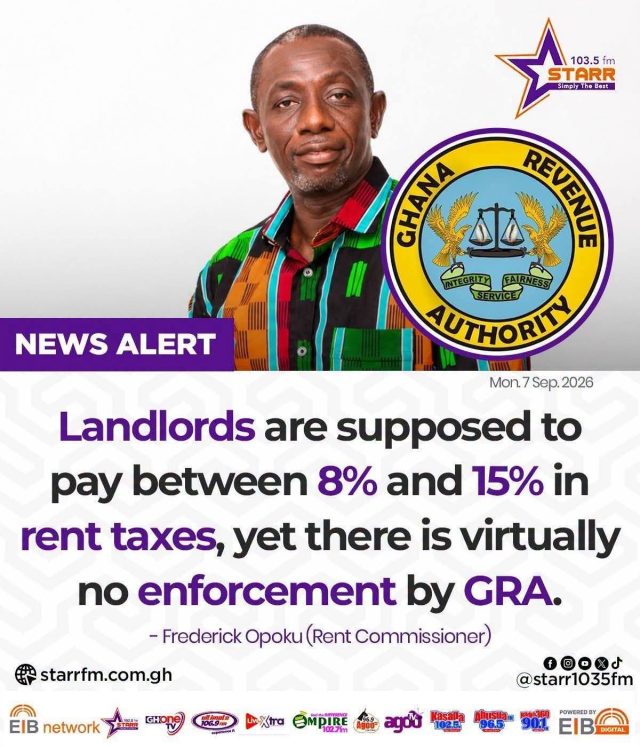
By statutory law under Act 896, residential rent carries an 8% final withholding tax; commercial runs at 15%. Yet tenant advocates and real estate observers have pointed out the obvious for years: enforcement is practically an urban myth.
Landlords routinely demand one to two years of upfront cash or private mobile money transfers, hand out handwritten paper receipts, and bypass the central tax registry with zero consequence.
Whenever this gets challenged, the bureaucracy pulls off its favorite operational feint: deliberately conflating municipal property rates with central rental income tax. Officials hide behind the fact that Metropolitan, Municipal, and District Assemblies (MMDAs) struggle to collect local property rates under the Local Governance Act. But that’s a red herring.
Property rating is a local municipal asset charge; rent tax is a direct national income levy under the GRA’s explicit jurisdiction. Blaming messy local assembly valuation rolls is simply an administrative shield to excuse the central government’s total failure to audit rental cash flows.
The downstream impact on capital formation is devastating.
Fiscal managers publicly lament that Ghanaians don’t invest enough in the productive economy—that there isn’t enough indigenous capital backing public equities on the local exchange, corporate debt, or domestic ventures. But do the math: from where, exactly, is that surplus supposed to accumulate?
When you extract 35% from the marginal cash flow of the only salaried tier with the financial literacy, institutional trust, and banking access to capitalize domestic markets, you liquidate your retail investor class before it even forms. Worse, you signal to every rational actor that the smartest play in town is to bury liquidity into untaxed, cash-generating concrete blocks where the taxman never sets foot.
Which brings us to the opacity of the reporting.
Can the GRA produce a granular, machine-readable breakdown of rent tax collected across each of Ghana’s 261 MMDAs? They cannot—or more accurately, they choose not to.
Hiding behind national aggregate numbers is the ultimate bureaucratic cloaking device. If you disaggregate direct taxes by district, the narrative collapses. It would expose that rental tax yields are an embarrassing rounding error, and that headline targets are met almost entirely through inflation and bracket creep squeezed out of captive corporate paychecks.
And ask yourself the obvious question: who actually benefits from maintaining that obscurity?
Could it be a political and administrative elite whose own private balance sheets are disproportionately parked in prime residential compounds and commercial high-rises?
Does it protect an off-the-books cash economy that treats physical brick-and-mortar as the ultimate unmonitored store of value?
Or does it simply protect revenue administrators who would rather hit easy macro targets off corporate payroll software than burn political capital knocking on the gates of connected landlords?
The technological excuse expired years ago. The state already spent the money deploying digital property addresses via GhanaPost GPS, rolling out biometric Ghana Cards, and digitizing utility accounts. Matching multi-unit residential meters at ECG or Ghana Water against registered rental withholding filings isn’t speculative science—it is entry-level data engineering.
If the state wants the moral authority to preach about tax mobilization, it has to end the double standard. Mandate open-data district ledgers. Cross-reference the meter rolls with the tax registry.
If productive wage earners are forced to be fully transparent at source every thirty days, the untaxed property empires across the street shouldn’t get a permanent pass in the dark.
By: Sitsofe Mensah, Technology enthusiast, Google Executive and IMANI Associate