
Government is seeking to reduce the maximum initial duration of large scale mining leases in Ghana from 30 years to 20 years as part of a wider overhaul of the country’s minerals and mining regime.
Minister for Lands and Natural Resources Emmanuel Armah Kofi Buah says the proposed reform is intended to prevent mining companies and concession holders from tying up Ghana’s mineral resources for decades without sufficiently developing them.
He disclosed the policy direction during a strategic working visit and policy dialogue between the Ministry of Lands and Natural Resources and the IMANI Centre for Policy and Education in Accra.
The engagement followed IMANI’s August 10, 2026 request for a structured assessment of the Ministry’s inherited situation, performance, operational challenges, reforms and major policy initiatives.
Present at the meeting were Armah Kofi Buah, senior officials of the Ministry and representatives of agencies under it, including the Minerals Commission, Forestry Commission, Lands Commission and Ghana Geological Survey Authority.
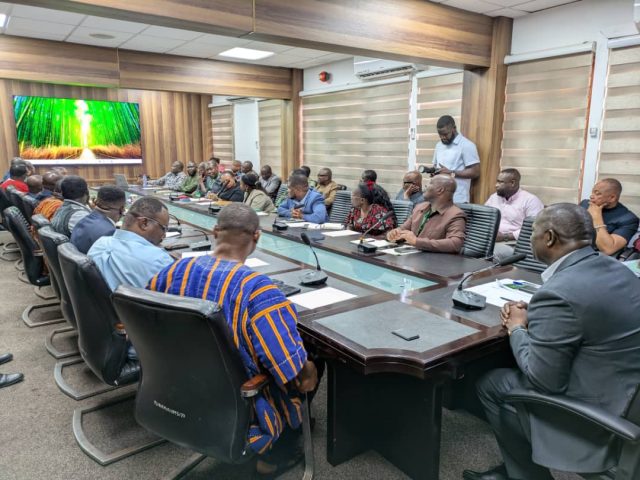
The IMANI delegation was led by Franklin Cudjoe, Founding President and CEO of IMANI, and included Selorm Branttie, Vice President for Strategy; Kay Codjoe, writer and IMANI associate; and Ransford Brobbey, IMANI associate.
According to the Minister, government has completed a major review of mining policy which is now being translated into proposed legislation before Parliament.
One of the most significant changes concerns the length of mining leases.
Under the existing arrangement described by the Minister, a large scale mining lease can run for as long as 30 years.
Government wants the maximum initial period reduced to 20 years.
“Twenty years, whatever profit you want to make, you want to make it,” Kofi Buah told the meeting, arguing that the State must retain an opportunity to reconsider the use of its mineral resources after a reasonable period.
But the proposed reforms go beyond the headline 20 year limit.
Government also intends to tighten the rules governing reconnaissance, prospecting and exploration licences.
Kofi Buah said Ghana has suffered from a system in which individuals and companies acquire mineral concessions and hold them for long periods without carrying out serious exploration or mining.
According to him, some concession holders effectively wait for larger investors to arrive before attempting to sell or transfer their interests.
“The whole of Ghana has basically been given out and people are just sitting on concessions for 30, 40 years. They are not doing anything. They are waiting for the next big investor to come so they can cash out.”
The new approach would impose stricter work obligations and timelines.
The Minister indicated that concession holders would have to demonstrate within specified periods that genuine exploration and development activity is taking place.
He also outlined a proposed five year framework for exploration related rights, with licence holders expected to demonstrate seriousness through approved work programmes.
Another major reform would give mining communities a greater role before licences are issued.
Government is proposing District Mining Committees that would examine applications affecting particular communities before final decisions are taken.
Under the system described by the Minister, officials would visit the proposed mining area and assess issues including water bodies, farms, settlements and other community interests before making recommendations to the Minerals Commission.
The reforms would also require mining companies to enter into community development agreements with affected communities.
Kofi Buah said this would prevent companies from unilaterally deciding what constitutes corporate social responsibility while communities have different development priorities.
The community and mining company would instead establish agreed development obligations covering identified local needs.
The discussion also touched on the Adamus Resources matter. Franklin Cudjoe urged the Ministry to give the company a final structured opportunity to correct identified breaches, while stressing that Ghanaian investors should receive the same regulatory fairness and protection extended to foreign investors.
Kofi Buah indicated that the Ministry remained open to engagement where an operator was genuinely willing to comply.
The proposed reforms therefore raise a much bigger question than simply whether mining leases should last 20 or 30 years.
They represent an attempt to change who controls Ghana’s mineral concessions, how long those rights can be held, what licence holders must do to retain them, and how much influence mining communities have over what happens on their land.
The next critical test will be Parliament.
The precise provisions that survive the legislative process will determine whether Ghana genuinely ends the era of dormant concessions or merely replaces one licensing regime with another.
By: Kay Codjoe, IMANI Associate


