More than 4,000 excavators are currently being held at Ghana’s ports as government enforces a new clearance, documentation and tracking regime intended to prevent heavy earthmoving equipment from being diverted into illegal mining.
Minister for Lands and Natural Resources Emmanuel Armah Kofi Buah disclosed that importers are now required to establish the intended owner, end user and operational destination of excavators before the machines can be released from the ports.
The disclosure was made during a strategic working visit and policy dialogue between the Ministry of Lands and Natural Resources and the IMANI Centre for Policy and Education in Accra.
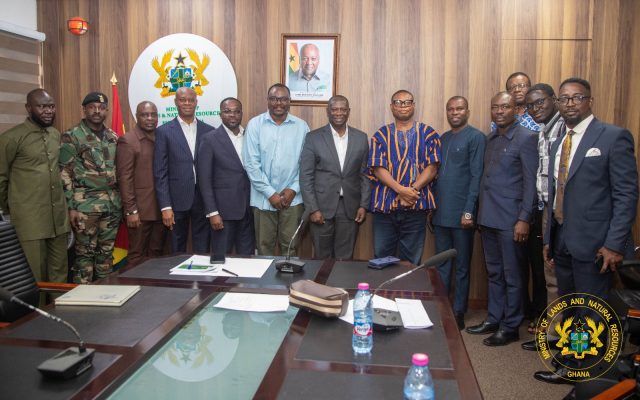
The engagement followed an August 10, 2026 request by IMANI for a fact finding dialogue covering the Ministry’s inherited baseline, performance, operational challenges and key policy interventions.
Present at the engagement were Minister Emmanuel Armah Kofi Buah, senior officials of the Ministry and representatives of agencies under it, including the Minerals Commission, Forestry Commission, Lands Commission and Ghana Geological Survey Authority.
The IMANI delegation was led by Franklin Cudjoe, Founding President and CEO of IMANI, and included Selorm Branttie, Vice President for Strategy; Kay Codjoe, writer and IMANI associate; and Ransford Brobbey, IMANI associate.
According to the Minister, the previous system allowed excavators to enter Ghana without an effective mechanism for determining where the equipment ultimately ended up.
That, he argued, created an important loophole in the fight against illegal mining. The new regime seeks to close it.
“Over 4,000 excavators are still sitting, waiting for the owners to begin,” the Minister said during the presentation, explaining that importers must now provide documentation before their equipment can be cleared.
He said the Minerals Commission has established a regulatory presence at the port so that the documentation of mining equipment can be checked before Customs clearance.
Under the arrangement, an importer must identify who the equipment is being imported for, its intended destination and the mining operation where it will be used.
The Ministry says approved excavators can subsequently be fitted with tracking technology and geographically restricted to declared operating areas.
If a machine declared for one concession is moved into another mining area, regulators should therefore be capable of detecting the deviation.
Kofi Buah said the ultimate objective is to bring every excavator operating in Ghana into a traceable national system.
The Minister acknowledged, however, that commercial importation poses a challenge.
Some businesses import excavators in bulk for subsequent sale without knowing their eventual buyers at the time the machines arrive.
Government is insisting that such importers provide evidence of legitimate orders or identifiable end users before the equipment is released.
“If you are importing 200 excavators, we have to know where those excavators are going,” he explained in substance.
The port controls form part of a wider attempt to attack not only illegal miners on the ground, but also the equipment supply chain sustaining illegal mining operations.
Data separately presented by the Ministry on illegal mining in forest reserves shows the scale of heavy equipment already encountered during enforcement operations.
As of July 2026, authorities had:
- seized 200 excavators
- immobilised another 34 excavators
- arrested 258 suspects
- seized 1,469 pumping machines
- immobilised 1,259 pumping machines
- seized 950 changfan machines
- immobilised another 774 changfan machines
The numbers raise a larger policy question for government.
If excavators have been one of the principal tools driving destructive mining, controlling them before they reach illegal mining sites could prove more effective than repeatedly deploying security personnel to seize them after environmental damage has occurred.
The next test will therefore be whether the Ministry can demonstrate that the new system provides an uninterrupted trail from port clearance to ownership, concession and actual location in the field.
It will also have to establish what happens when an excavator breaches its approved geographical area, who receives the alert, how quickly enforcement follows and what sanctions apply to the registered owner.
The discussion also broadened into the treatment of legitimate investors when regulatory breaches occur.
Franklin Cudjoe urged the Minister to consider offering Adamus Resources a final pathway through which the company could be shepherded by the Ministry to correct identified breaches and comply fully with the requirements of any future agreement.
He argued that regulation should remain firm while allowing remediation for investors prepared to comply with the law, stressing that Ghanaian mining investors must receive the same institutional protection, fairness and opportunity to regularise their operations as foreign investors.
The Minister indicated that the Ministry was open to such engagement where an operator demonstrated a genuine willingness to correct breaches and ensure that the problems did not recur.
That exchange adds another dimension to the broader mining reforms. Enforcement, the participants suggested, must be strict enough to protect Ghana’s resources but also predictable, even handed and capable of distinguishing between operators willing to correct breaches and those deliberately circumventing the law.
For a government battling illegal mining on multiple fronts, the significance of the new equipment control system remains straightforward:
Ghana is attempting to move the fight against galamsey from chasing excavators in forests to knowing where they are before they ever reach the forest.
By: Kay Codjoe, IMANI Associate