
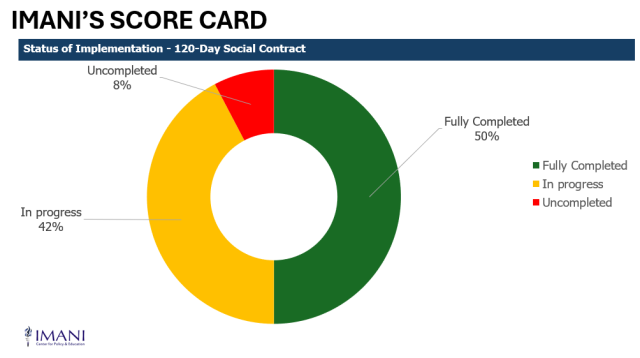
On Wednesday, May 7, 2025, IMANI Africa delivered a detailed review of President John Dramani Mahama’s first 120 days in office, rating the administration’s progress at 50% on the commitments made in its widely publicised 120-Day Social Contract. The evaluation, guided by the NDC’s own 120-Day Social Contract, was shared during a special live edition of PM Express on JoyNews.
Our review measured the extent to which the Mahama administration has delivered on the 26 promises outlined in the Social Contract, covering critical sectors such as the economy, governance, education, and natural resources.
Findings at a Glance
Of the 26 promises assessed:
-
13 were fully delivered
-
11 are in progress
-
2 remain unfulfilled
While we acknowledge the government’s early efforts to operationalise several commitments, many of the implemented actions lack the strategic depth and fiscal discipline necessary to anchor long-term reform. Some initiatives have been embedded in the 2025 national budget, yet clear frameworks for implementation and impact measurement remain absent.
Progress amid Persistent Structural Challenges
Ghana’s recovery under the ongoing IMF-supported programme provides a critical window for transformation. However, our analysis shows that many of the government’s initial actions fall short of addressing the deep structural deficiencies in public financial management, institutional governance, and accountability.
Flagship programmes, such as the 24-Hour Economy, Youth in Agriculture, and the Women’s Development Bank, reflect ambition but risk becoming fiscal burdens if not grounded in rigorous design, productivity metrics, and sustainable financing models.
Our projections indicate that seven of the flagship initiatives could cost the public purse over GHC19 billion, representing more than 10% of projected domestic revenue. Yet, limited details exist on how these programmes will deliver value-for-money and reduce long-term liabilities.
Governance: The Core Reform Challenge
Beyond economics, we found limited progress in confronting governance-related constraints. Issues such as political patronage, opacity in public procurement, and inefficient state-owned enterprises (SOEs) persist. We are particularly concerned about the lack of clarity around reforms in tax policy, SOE restructuring, and public sector accountability pillars that are essential to restoring fiscal stability and institutional credibility.
Our Key Recommendations
To ensure the NDC government’s efforts translate into sustained national progress, IMANI recommends the following:
-
Refocus public expenditure on high-impact, measurable programmes.
-
Enhance tax equity and compliance by limiting exemptions and broadening the base.
-
Restructure SOEs through competitive partnerships and performance audits.
-
Strengthen fiscal rules and independent oversight bodies to track reforms.
-
Encourage citizen-led accountability mechanisms to keep government responsive.
Conclusion
This 120-Day assessment is part of IMANI Africa’s ongoing commitment to promoting evidence-based policymaking and institutional accountability. While we recognise steps taken by the Mahama administration, our findings call for deeper, more courageous reforms.
In the absence of stronger citizen engagement and long-term policy coherence, early political wins may fail to resolve Ghana’s enduring structural problems. We urge the government and its stakeholders to act decisively on the insights and recommendations presented.
We extend our gratitude to JoyNews for providing the platform for this national conversation and to all stakeholders who continue to support our mission of improving governance through constructive policy engagement.
Watch the full presentation here: https://youtu.be/RCp0yzn1aGU


