Monitoring Period: 1st – 30th September 2026
The IMANI Public Understanding and Literacy for Sentiment and Election analysis (PULSE) framework is designed to assess public sentiment across digital and media ecosystems regarding major political contenders, identifying dominant narratives, emerging trends, and key influencers shaping online political discourse.
The analysis draws on data and content from the following platforms:
- Facebook
- X (formerly Twitter)
- YouTube
- Web-based sources
- TikTok
- Podcasts
- News feeds
Ghana’s online political conversation in September 2026 was dominated by political personalities, parliamentary confrontation, narcotics-related controversies, and persistent economic concerns. Across the month, the IMANI Pulse monitored 17,806 public posts across X, Facebook, and TikTok, generating 4,838 figure-tagged sentiment readings across seven political figures and tracking 16 keywords. No posts were flagged as coordinated activity during the period.

Key findings for the month
- Mahama dominated the conversation: He drew 2,745 of 4,838 figure-tagged readings (57%), more than the next five figures combined. His tone was almost exactly balanced: 1,360 positive against 1,125 negative, a mean of-0.01.
- Afenyo-Markin had the most negative: 66% of his 454 mentions were negative (mean -0.27), as the Minority Leader’s “24-hour cocaine economy” attack and its walk-back ran alongside the narcotics-probe clash in Parliament.
- Bawumia and Ato Forson finished slightly positive (+0.07 and +0.04), the only two figures above zero for the month.
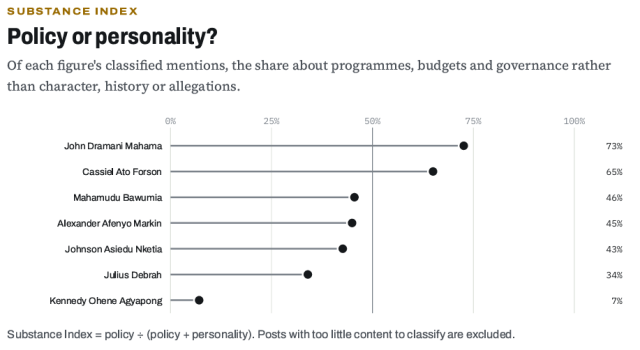
- Mahama’s coverage was the most policy-focused. 73% of his classified mentions were about policy, against 46% for Bawumia and 7% for Agyapong, whose coverage was almost entirely about personality.
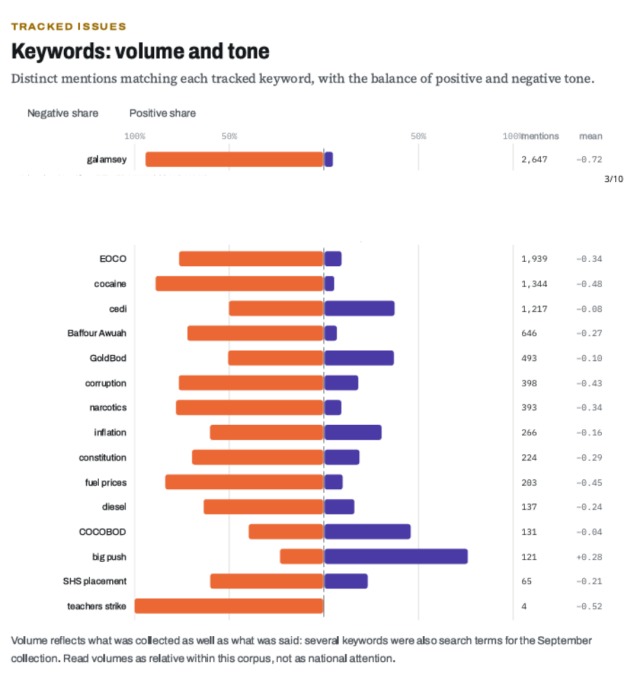
- Galamsey was the month’s loudest and most negative issue, with 2,647 mentions, 94% of them The narcotics story followed: cocaine (1,344, 89% negative), EOCO (1,939) and narcotics (393).
- The cedi split opinion; the Big Push was the one clear: Cedi mentions were mixed (454 positive, 610 negative), while the Big Push infrastructure programme ran net positive (+0.28).
- On the economy, currency and fuel led the volume; cost of living and debt hurt: Currency (1,361) and fuel and energy (1,135) drew the most mentions. Cost of living (-0.25), debt and the IMF (-0.24), and fuel (-0.23) carried the most negative tone.
The month’s conversation was particularly notable for the contrast between volume and sentiment. President John Dramani Mahama remained by far the most discussed political figure, accounting for 2,745 mentions, or 57% of all figure-tagged readings. Yet the scale of his visibility did not translate into strongly positive or negative sentiment. His mean sentiment score of -0.01 was effectively neutral, with 1,360 positive mentions against 1,125 negative ones.
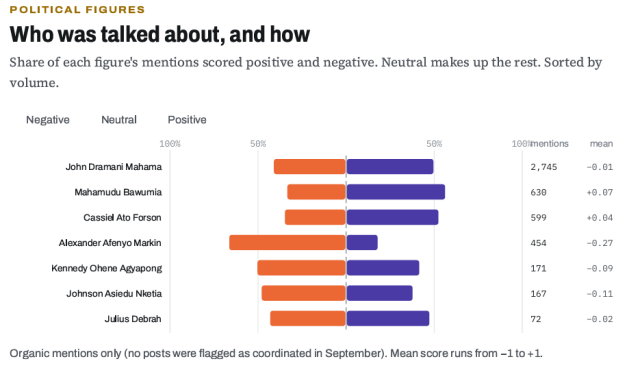
The visual distribution of political figures reinforces this dominance. Mahama’s bar is substantially larger than those of every other tracked figure, with Bawumia at 630 mentions, Ato Forson at 599 and Afenyo-Markin at 454. The gap is significant: Mahama generated more conversation than the next five figures combined. This suggests that September’s political discourse remained heavily centred on the presidency, even when the substance of the discussion was driven by controversies involving other actors.
Mahama: High Visibility, Near-Perfect Sentiment Balance
Mahama’s September performance presents an important distinction between being talked about and being talked about positively. His 2,745 mentions dwarfed those of his political counterparts, but his sentiment score remained almost exactly balanced at -0.01.
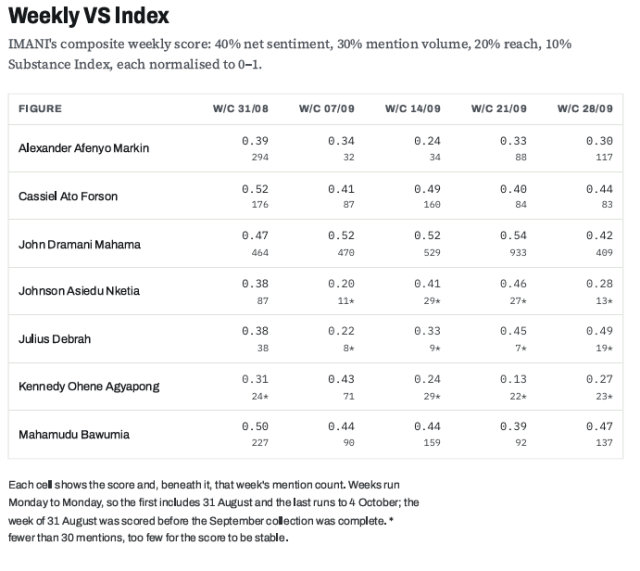
The weekly sentiment chart also shows that Mahama maintained comparatively stable scores through much of the month, while his volume increased sharply in the final week. His weekly mention count rose from 464 in the week beginning 31 August to 933 in the week beginning 21 September, before falling to 409 in the final partial week. His corresponding IMANI Pulse Index reached 0.54 in the week of 21 September, the strongest weekly score recorded for him during the period.
More importantly, Mahama’s conversation was the most policy-oriented among the major political figures. His Substance Index stood at 73%, meaning nearly three-quarters of his classifiable mentions concerned policy, programmes, budgets or governance rather than personality, history or allegations. This was significantly higher than Bawumia’s 46% and dramatically above Kennedy Agyapong’s 7%. This makes Mahama’s September profile distinctive: high volume, relatively balanced sentiment, and the strongest policy orientation among the figures tracked.
Afenyo-Markin: The Month’s Most Negative Political Figure
If Mahama dominated by volume, Alexander Afenyo-Markin dominated the negative end of the political sentiment spectrum.
The Minority Leader recorded 454 mentions, with 66% classified as negative, producing a mean sentiment score of -0.27, the lowest among the seven tracked figures.
The visual weekly trend helps explain this. Afenyo-Markin’s conversation moved through several controversies during the month, including the GoldBod losses debate, parliamentary disputes, education concerns and, most significantly, the late-September narcotics controversy.
The final week’s narrative was particularly consequential. Between 24 and 30 September, Afenyo-Markin’s parliamentary offensive over major cocaine seizures generated sustained attention. His “24-hour cocaine economy” attack on Mahama’s flagship policy became a major online talking point, while his confrontation with the government over a parliamentary inquiry added another layer of negativity to the conversation. The week’s overall sentiment was -0.06, with Afenyo-Markin receiving considerable narrative prominence despite Mahama remaining the most-mentioned figure.
His 45% Substance Index suggests that the conversation around him was almost evenly divided between policy and personality-related content. This is significant because the issues that generated his strongest visibility were themselves highly contentious, particularly the parliamentary and narcotics disputes.
Bawumia and Ato Forson: The Only Positive Territory
Dr Mahamudu Bawumia and Dr Cassiel Ato Forson were the only two tracked figures to finish September with positive mean sentiment.
Bawumia recorded 630 mentions and a +0.07 mean score, while Ato Forson recorded 599 mentions and +0.04.
Their positive scores were modest rather than overwhelming. The weekly IMANI Pulse Index shows Bawumia fluctuating between 0.39 and 0.50, while Ato Forson’s score ranged between 0.40 and 0.52. Neither figure dominated the conversation by volume, but both maintained relatively resilient weekly scores.
Ato Forson’s position is particularly interesting because his September conversation intersected with competing narratives around Ghana’s economic performance and the proposed “New Economy” agenda. The second week of the month, for instance, recorded a positive composite sentiment of +0.07 and a Substance Index of 0.72, the highest weekly substance score in the report. The conversation centred heavily on economic policy, GDP growth, and the Finance Minister’s policy agenda.
Galamsey Remains Ghana’s Most Negative Issue
Beyond individual politicians, galamsey was the month’s defining negative issue.
The tracked keyword generated 2,647 mentions, making it one of the most visible issues in the dataset, while registering an extraordinary -0.72 mean sentiment score.
The weekly heatmap makes the persistence of the issue particularly clear. Galamsey remained consistently active across every week, moving from 505 mentions in the week beginning 31 August to 668 in the final week of September. Unlike some issues that spiked sharply around a single event, galamsey maintained a relatively high baseline throughout the month.
This combination of high volume and strongly negative sentiment makes galamsey arguably the clearest indicator of public frustration within the monitored conversation.
The Narcotics Story Reshaped the Final Weeks
The other major shift in September came from the narcotics-related conversation.
EOCO recorded 1,939 mentions with a -0.34 mean score, while cocaine generated 1,344 mentions and a much more negative -0.48 score. Narcotics itself recorded 393 mentions at -0.34.
The weekly visualisation shows the extraordinary nature of the spike. EOCO moved from just 34 mentions in the week of 14 September to 1,364 in the week of 21 September, before declining to 450 in the final week. Baffour Awuah similarly jumped from 16 mentions to 504 in the same period. Cocaine mentions also climbed sharply from 2 at the beginning of the month to 410 and then 440 in successive weeks.
The data therefore captures a clear transition in the month’s political agenda: the conversation moved from a broad mix of governance and economic issues towards a concentrated narcotics and parliamentary confrontation in the latter part of September.
The Economy: People Talked About Currency and Fuel, But Felt Cost of Living and Debt
Economic conversation remained substantial throughout the month, although its emotional character was predominantly negative.
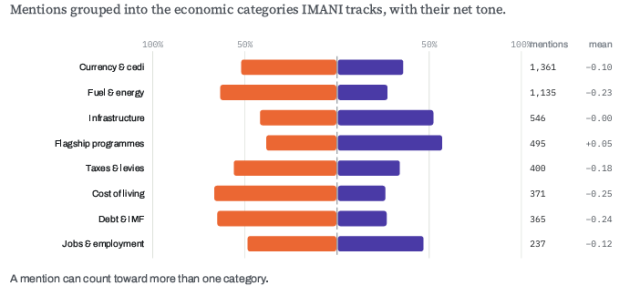
Currency and cedi generated the highest volume among the economic categories, with 1,361 mentions, followed by fuel and energy with 1,135. Yet the most negative economic categories were cost of living (-0.25), debt and the IMF (-0.24), and fuel (-0.23).
The distinction matters. High-volume issues are not necessarily the issues generating the strongest frustration. The cedi, for example, recorded 1,217 keyword mentions and a -0.08 mean score, suggesting a considerably more mixed conversation than the much harsher sentiment attached to cocaine, corruption, fuel prices or galamsey.
The economic visual therefore presents a familiar but important pattern: currency and fuel dominate attention, while the cost of living and debt generate deeper negative sentiment.
The Big Push Provides a Rare Positive Economic Narrative
Against this largely negative economic backdrop, the government’s Big Push infrastructure programme stood out.
The issue generated only 121 mentions, substantially below currency, fuel or the major political controversies, but it recorded a +0.28 mean sentiment score, making it the clearest positive issue in the economic and policy dataset.
This is an important example of why volume alone is insufficient for interpreting online political sentiment. The Big Push did not dominate the conversation, but where it appeared, the tone was considerably more favourable.
Similarly, flagship programmes collectively recorded a +0.05 mean score, while infrastructure was effectively neutral at -0.00.
September’s Political Conversation Became More Confrontational as the Month Progressed
The week-by-week data shows a clear evolution.
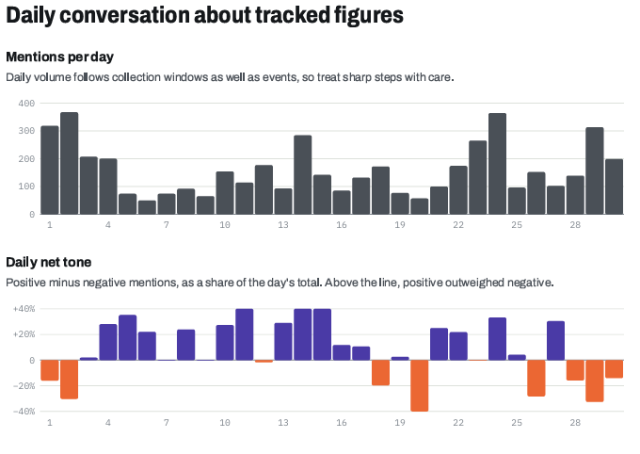
The first week was broadly negative, with the composite conversation recording -0.05 sentiment and a Substance Index of 0.57. GoldBod, the Afenyo-Markin/GoldBod legal dispute and the $1.7 billion losses controversy featured prominently.
The second week was markedly more positive, with sentiment rising to +0.07 and the Substance Index reaching 0.72. Education concerns, economic performance and the government’s economic agenda dominated the conversation.
The third week turned negative again at -0.04, driven partly by the NDC 2028 flagbearer debate and accusations surrounding misinformation and the 2028 political contest.
The final week produced another negative reading of -0.06, but this time the conversation was substantially more concentrated around narcotics seizures, parliamentary confrontation and the “24-hour cocaine economy” controversy.
Taken together, the weekly visual tells a story of an increasingly adversarial political conversation, with September moving from economic and governance debates towards sharper political conflict and scandal-driven discourse.
CONCLUSION
September 2026 presents a Ghanaian online political conversation that was highly active, increasingly confrontational and uneven in its relationship with policy.
President John Dramani Mahama remained the dominant political figure by a considerable margin, but his near-neutral sentiment score demonstrates that visibility should not be mistaken for approval or disapproval.
The stronger emotional signals came elsewhere.
Galamsey generated the month’s deepest negative sentiment. Narcotics-related controversies reshaped the conversation towards the end of the month. Economic hardship remained a persistent source of concern, particularly around cost of living, debt and fuel. And parliamentary confrontation increasingly became a vehicle through which broader questions of governance and accountability were debated.
At the same time, the September data provides evidence that substantive political discussion has not disappeared. Mahama’s 73% Substance Index, Ato Forson’s 65% and the positive sentiment around the Big Push show that policy-oriented conversation can still generate meaningful engagement and favourable sentiment.
The central challenge, therefore, is not simply to ask whether Ghana’s online political conversation is positive or negative.
It is to ask what is driving the sentiment, whether citizens are debating policies or personalities, and whether moments of intense political attention are translating into meaningful conversations about governance and public outcomes.
September’s data suggests that controversy remains one of the strongest engines of online political attention, but policy continues to shape the conversation beneath it.
METHODOLOGY
Data
IMANI PULSE collected 17,806 public posts published between 1 and 30 September 2026 from X (14,171), Facebook (3,484) and TikTok (151).
A total of 4,838 sentiment readings linked posts to one of seven tracked political figures. A post mentioning two tracked figures could therefore contribute one reading to each figure.
Posts that named neither a tracked figure nor a tracked keyword were retained but not scored.
Sampling
This is a targeted sample, not a census of Ghanaian online conversation.
The collection searched for tracked political figures and a keyword list refreshed from September news headlines. Keyword volumes therefore reflect both what was said and what was searched for.
Consequently, issue volumes should be compared within this corpus and should not be interpreted as a direct measure of national attention.
Facebook coverage consists of 19 public news and media pages, while TikTok coverage remains comparatively thin.
Sentiment scoring
Each post was scored using a multilingual social-media sentiment model and adjusted with IMANI’s Ghanaian political lexicon, including local expressions and Twi-English code-switching.
Sentiment scores range from -1 to +1.
Substance Index
The Substance Index measures the share of classifiable mentions concerned with policy, programmes, budgets and governance, rather than personality, history, allegations or political identity.
Posts with insufficient content to classify are excluded from the ratio.
Coordinated activity
Posts flagged as potentially coordinated are excluded from the analysis.
No posts were flagged as coordinated in September 2026.
Weekly summaries
The weekly narrative summaries were generated by a language model from samples of posts and the associated metrics.
They describe the stories driving the conversation and should not be interpreted as editorial judgement. In September, the generated summaries consistently gave Afenyo-Markin more prominence than his actual share of mentions. For this reason, the report separately presents the most-mentioned figures based on the underlying data.

IMANI PULSE – Mahama Dominates Ghana’s Political Conversation as Galamsey, Narcotics and Economic Pain Drive Negative Sentiment
Monitoring Period: 1st – 30th September 2026
The IMANI Public Understanding and Literacy for Sentiment and Election analysis (PULSE) framework is designed to assess public sentiment across digital and media ecosystems regarding major political contenders, identifying dominant narratives, emerging trends, and key influencers shaping online political discourse.
The analysis draws on data and content from the following platforms:
Ghana’s online political conversation in September 2026 was dominated by political personalities, parliamentary confrontation, narcotics-related controversies, and persistent economic concerns. Across the month, the IMANI Pulse monitored 17,806 public posts across X, Facebook, and TikTok, generating 4,838 figure-tagged sentiment readings across seven political figures and tracking 16 keywords. No posts were flagged as coordinated activity during the period.
Key findings for the month
The month’s conversation was particularly notable for the contrast between volume and sentiment. President John Dramani Mahama remained by far the most discussed political figure, accounting for 2,745 mentions, or 57% of all figure-tagged readings. Yet the scale of his visibility did not translate into strongly positive or negative sentiment. His mean sentiment score of -0.01 was effectively neutral, with 1,360 positive mentions against 1,125 negative ones.
The visual distribution of political figures reinforces this dominance. Mahama’s bar is substantially larger than those of every other tracked figure, with Bawumia at 630 mentions, Ato Forson at 599 and Afenyo-Markin at 454. The gap is significant: Mahama generated more conversation than the next five figures combined. This suggests that September’s political discourse remained heavily centred on the presidency, even when the substance of the discussion was driven by controversies involving other actors.
Mahama: High Visibility, Near-Perfect Sentiment Balance
Mahama’s September performance presents an important distinction between being talked about and being talked about positively. His 2,745 mentions dwarfed those of his political counterparts, but his sentiment score remained almost exactly balanced at -0.01.
The weekly sentiment chart also shows that Mahama maintained comparatively stable scores through much of the month, while his volume increased sharply in the final week. His weekly mention count rose from 464 in the week beginning 31 August to 933 in the week beginning 21 September, before falling to 409 in the final partial week. His corresponding IMANI Pulse Index reached 0.54 in the week of 21 September, the strongest weekly score recorded for him during the period.
More importantly, Mahama’s conversation was the most policy-oriented among the major political figures. His Substance Index stood at 73%, meaning nearly three-quarters of his classifiable mentions concerned policy, programmes, budgets or governance rather than personality, history or allegations. This was significantly higher than Bawumia’s 46% and dramatically above Kennedy Agyapong’s 7%. This makes Mahama’s September profile distinctive: high volume, relatively balanced sentiment, and the strongest policy orientation among the figures tracked.
Afenyo-Markin: The Month’s Most Negative Political Figure
If Mahama dominated by volume, Alexander Afenyo-Markin dominated the negative end of the political sentiment spectrum.
The Minority Leader recorded 454 mentions, with 66% classified as negative, producing a mean sentiment score of -0.27, the lowest among the seven tracked figures.
The visual weekly trend helps explain this. Afenyo-Markin’s conversation moved through several controversies during the month, including the GoldBod losses debate, parliamentary disputes, education concerns and, most significantly, the late-September narcotics controversy.
The final week’s narrative was particularly consequential. Between 24 and 30 September, Afenyo-Markin’s parliamentary offensive over major cocaine seizures generated sustained attention. His “24-hour cocaine economy” attack on Mahama’s flagship policy became a major online talking point, while his confrontation with the government over a parliamentary inquiry added another layer of negativity to the conversation. The week’s overall sentiment was -0.06, with Afenyo-Markin receiving considerable narrative prominence despite Mahama remaining the most-mentioned figure.
His 45% Substance Index suggests that the conversation around him was almost evenly divided between policy and personality-related content. This is significant because the issues that generated his strongest visibility were themselves highly contentious, particularly the parliamentary and narcotics disputes.
Bawumia and Ato Forson: The Only Positive Territory
Dr Mahamudu Bawumia and Dr Cassiel Ato Forson were the only two tracked figures to finish September with positive mean sentiment.
Bawumia recorded 630 mentions and a +0.07 mean score, while Ato Forson recorded 599 mentions and +0.04.
Their positive scores were modest rather than overwhelming. The weekly IMANI Pulse Index shows Bawumia fluctuating between 0.39 and 0.50, while Ato Forson’s score ranged between 0.40 and 0.52. Neither figure dominated the conversation by volume, but both maintained relatively resilient weekly scores.
Ato Forson’s position is particularly interesting because his September conversation intersected with competing narratives around Ghana’s economic performance and the proposed “New Economy” agenda. The second week of the month, for instance, recorded a positive composite sentiment of +0.07 and a Substance Index of 0.72, the highest weekly substance score in the report. The conversation centred heavily on economic policy, GDP growth, and the Finance Minister’s policy agenda.
Galamsey Remains Ghana’s Most Negative Issue
Beyond individual politicians, galamsey was the month’s defining negative issue.
The tracked keyword generated 2,647 mentions, making it one of the most visible issues in the dataset, while registering an extraordinary -0.72 mean sentiment score.
The weekly heatmap makes the persistence of the issue particularly clear. Galamsey remained consistently active across every week, moving from 505 mentions in the week beginning 31 August to 668 in the final week of September. Unlike some issues that spiked sharply around a single event, galamsey maintained a relatively high baseline throughout the month.
This combination of high volume and strongly negative sentiment makes galamsey arguably the clearest indicator of public frustration within the monitored conversation.
The Narcotics Story Reshaped the Final Weeks
The other major shift in September came from the narcotics-related conversation.
EOCO recorded 1,939 mentions with a -0.34 mean score, while cocaine generated 1,344 mentions and a much more negative -0.48 score. Narcotics itself recorded 393 mentions at -0.34.
The weekly visualisation shows the extraordinary nature of the spike. EOCO moved from just 34 mentions in the week of 14 September to 1,364 in the week of 21 September, before declining to 450 in the final week. Baffour Awuah similarly jumped from 16 mentions to 504 in the same period. Cocaine mentions also climbed sharply from 2 at the beginning of the month to 410 and then 440 in successive weeks.
The data therefore captures a clear transition in the month’s political agenda: the conversation moved from a broad mix of governance and economic issues towards a concentrated narcotics and parliamentary confrontation in the latter part of September.
The Economy: People Talked About Currency and Fuel, But Felt Cost of Living and Debt
Economic conversation remained substantial throughout the month, although its emotional character was predominantly negative.
Currency and cedi generated the highest volume among the economic categories, with 1,361 mentions, followed by fuel and energy with 1,135. Yet the most negative economic categories were cost of living (-0.25), debt and the IMF (-0.24), and fuel (-0.23).
The distinction matters. High-volume issues are not necessarily the issues generating the strongest frustration. The cedi, for example, recorded 1,217 keyword mentions and a -0.08 mean score, suggesting a considerably more mixed conversation than the much harsher sentiment attached to cocaine, corruption, fuel prices or galamsey.
The economic visual therefore presents a familiar but important pattern: currency and fuel dominate attention, while the cost of living and debt generate deeper negative sentiment.
The Big Push Provides a Rare Positive Economic Narrative
Against this largely negative economic backdrop, the government’s Big Push infrastructure programme stood out.
The issue generated only 121 mentions, substantially below currency, fuel or the major political controversies, but it recorded a +0.28 mean sentiment score, making it the clearest positive issue in the economic and policy dataset.
This is an important example of why volume alone is insufficient for interpreting online political sentiment. The Big Push did not dominate the conversation, but where it appeared, the tone was considerably more favourable.
Similarly, flagship programmes collectively recorded a +0.05 mean score, while infrastructure was effectively neutral at -0.00.
September’s Political Conversation Became More Confrontational as the Month Progressed
The week-by-week data shows a clear evolution.
The first week was broadly negative, with the composite conversation recording -0.05 sentiment and a Substance Index of 0.57. GoldBod, the Afenyo-Markin/GoldBod legal dispute and the $1.7 billion losses controversy featured prominently.
The second week was markedly more positive, with sentiment rising to +0.07 and the Substance Index reaching 0.72. Education concerns, economic performance and the government’s economic agenda dominated the conversation.
The third week turned negative again at -0.04, driven partly by the NDC 2028 flagbearer debate and accusations surrounding misinformation and the 2028 political contest.
The final week produced another negative reading of -0.06, but this time the conversation was substantially more concentrated around narcotics seizures, parliamentary confrontation and the “24-hour cocaine economy” controversy.
Taken together, the weekly visual tells a story of an increasingly adversarial political conversation, with September moving from economic and governance debates towards sharper political conflict and scandal-driven discourse.
CONCLUSION
September 2026 presents a Ghanaian online political conversation that was highly active, increasingly confrontational and uneven in its relationship with policy.
President John Dramani Mahama remained the dominant political figure by a considerable margin, but his near-neutral sentiment score demonstrates that visibility should not be mistaken for approval or disapproval.
The stronger emotional signals came elsewhere.
Galamsey generated the month’s deepest negative sentiment. Narcotics-related controversies reshaped the conversation towards the end of the month. Economic hardship remained a persistent source of concern, particularly around cost of living, debt and fuel. And parliamentary confrontation increasingly became a vehicle through which broader questions of governance and accountability were debated.
At the same time, the September data provides evidence that substantive political discussion has not disappeared. Mahama’s 73% Substance Index, Ato Forson’s 65% and the positive sentiment around the Big Push show that policy-oriented conversation can still generate meaningful engagement and favourable sentiment.
The central challenge, therefore, is not simply to ask whether Ghana’s online political conversation is positive or negative.
It is to ask what is driving the sentiment, whether citizens are debating policies or personalities, and whether moments of intense political attention are translating into meaningful conversations about governance and public outcomes.
September’s data suggests that controversy remains one of the strongest engines of online political attention, but policy continues to shape the conversation beneath it.
METHODOLOGY
Data
IMANI PULSE collected 17,806 public posts published between 1 and 30 September 2026 from X (14,171), Facebook (3,484) and TikTok (151).
A total of 4,838 sentiment readings linked posts to one of seven tracked political figures. A post mentioning two tracked figures could therefore contribute one reading to each figure.
Posts that named neither a tracked figure nor a tracked keyword were retained but not scored.
Sampling
This is a targeted sample, not a census of Ghanaian online conversation.
The collection searched for tracked political figures and a keyword list refreshed from September news headlines. Keyword volumes therefore reflect both what was said and what was searched for.
Consequently, issue volumes should be compared within this corpus and should not be interpreted as a direct measure of national attention.
Facebook coverage consists of 19 public news and media pages, while TikTok coverage remains comparatively thin.
Sentiment scoring
Each post was scored using a multilingual social-media sentiment model and adjusted with IMANI’s Ghanaian political lexicon, including local expressions and Twi-English code-switching.
Sentiment scores range from -1 to +1.
Substance Index
The Substance Index measures the share of classifiable mentions concerned with policy, programmes, budgets and governance, rather than personality, history, allegations or political identity.
Posts with insufficient content to classify are excluded from the ratio.
Coordinated activity
Posts flagged as potentially coordinated are excluded from the analysis.
No posts were flagged as coordinated in September 2026.
Weekly summaries
The weekly narrative summaries were generated by a language model from samples of posts and the associated metrics.
They describe the stories driving the conversation and should not be interpreted as editorial judgement. In September, the generated summaries consistently gave Afenyo-Markin more prominence than his actual share of mentions. For this reason, the report separately presents the most-mentioned figures based on the underlying data.
Related Posts
The AFCFTA Ring Has Fifty-Four Flags and Zero Referees
Mahama Dominates Ghana’s Political Conversation as Galamsey, Corruption and Economic Pressures Shape Public Sentiment
More News/Articles
Ghana’s Digital Health Transition: From DHIMS1 and DHIMS2 to LHIMS, GHIMS and the 2026 Hosting Crisis
The AFCFTA Ring Has Fifty-Four Flags and Zero Referees
Mahama Dominates Ghana’s Political Conversation as Galamsey, Corruption and Economic Pressures Shape Public Sentiment
Subscribe to our newsletter