
The IMANI Public Understanding and Literacy for Sentiment and Election analysis (PULSE) framework is designed to assess public sentiment across digital and media ecosystems regarding major political contenders, identifying dominant narratives, emerging trends, and key influencers shaping online political discourse.
The analysis draws on data and content from the following platforms:
- X (formerly Twitter)
- YouTube
- Web-based sources
- TikTok
- Podcasts
- News feeds
The July 2026 IMANI PULSE analysis reveals a significant shift. It was a month of contestation. Economic indicators generated both optimism and anxiety. Government action was met with continued criticism. Law-enforcement activity prompted competing interpretations about accountability, political persecution and institutional independence. Economic gains became objects of partisan credit claims. Individual controversies became proxies for broader questions about institutional integrity.
Across TikTok, X, Facebook and monitored news sources, 3,880 mentions were captured during the 30-day period ending 10 August 2026. The overall substance index stood at 0.303, indicating that approximately 30 percent of classified content contained identifiable policy substance, while roughly 70 percent was primarily personality-driven. Overall sentiment was mildly negative at -0.069.
The overall sentiment score of -0.069 points to a mildly negative digital environment. But the negativity was neither uniform nor attributable to a single political actor.
Some criticism focused on the performance of the Mahama administration. Some revisited the economic and governance record of the previous NPP administration. Some arose from legal and prosecutorial controversies, while a considerable portion was generated by partisan confrontation and personality-driven exchanges.
The strongest individual political narratives centred on former Vice President Mahamudu Bawumia and President John Dramani Mahama.
Bawumia’s 30-day conversation was mildly negative, with a substance index of approximately 0.16. Much of the discussion surrounding him was connected to the controversy involving an associate identified in the dataset as Dennis Miracles Aboagye, alongside continued retrospective criticism of the economic record and promises associated with the previous NPP administration.
His emerging 2028 prospects received attention, but the conversation remained significantly more focused on the past than on a prospective political agenda.
President Mahama’s conversation was similarly dominated by personality. Of the classified mentions around him, 896 were personality-oriented compared with 361 policy-related mentions. His overall sentiment stood at -0.10.
Yet the Mahama conversation was substantively broader. It encompassed economic performance, infrastructure, employment, foreign policy, environmental initiatives, sanitation and assessments of his administration’s performance.
The distinction is important. Neither major political figure was being discussed solely through policy.
Their personalities had become the primary lens through which policies, controversies and institutional developments were interpreted.
One issue, different digital conversations
The platforms examined do not produce a single, uniform public conversation.
Facebook: A More Balanced Policy-Politics Mix
Facebook presents the most balanced picture in the dataset. Of the classified conversations, approximately 49% were policy-related and 51% personality-related, with a sentiment score close to neutral at +0.012. The sample was heavily populated by media-outlet pages, including Joy News, 3News and MyJoyOnline.
Economic management and the 2026 Mid-Year Budget Review were prominent. The conversation included competing interpretations of the government’s handling of illegal mining, the debt-to-GDP ratio, infrastructure and urban development. Constitutional reform, digital-sector employment, tourism and creative industries, and questions surrounding the Bank of Ghana also appeared.
Yet Facebook was not insulated from personality politics. The Dennis Miracles Aboagye prosecution became one of the most engaging stories in the sample, while internal NDC succession politics and Mahama’s performance rating also generated attention.
Facebook therefore provides the clearest example of policy and personality competing almost evenly for attention.
TikTok: Politics as Personality and Spectacle
TikTok is the sharpest departure from that pattern.
Only 10% of classified TikTok content was policy-related, compared with roughly 90% focused on personalities. Sentiment was mildly negative at -0.05.
The Dennis Miracles Aboagye controversy and the case involving the TikToker known as “Bawumia Ba” dominated the conversation. The latter generated exceptionally high engagement, with individual posts recording 352,014, 109,800 and 94,402 engagements respectively.
Mahama also appeared prominently, but largely through image, identity and symbolic leadership rather than detailed discussion of government programmes. Even where policy appeared, such as the discussion around anti-LGBTQ+ legislation, it represented a small portion of the overall conversation.
TikTok consequently illustrates the strongest concentration of political attention around people, identity, controversy and spectacle rather than programme-level debate.
Twitter/X: High Volume, Persistent Partisan Contestation
Twitter/X generated by far the largest volume in the monitored platform sample, with 3,176 mentions. But the substance index was only 0.29, meaning approximately 71% of classified content was personality-driven. Sentiment was also mildly negative at -0.08.
Here, the conversation moves rapidly between governance questions and partisan confrontation.
Mahama’s 24-hour economy, Tree for Life initiative, infrastructure development, sanitation and jobs all feature in the policy conversation. At the same time, Bawumia’s previous record is repeatedly revisited through debates over digitalisation, infrastructure promises and the credibility of past claims.
The platform also contains significant personal and partisan attacks, including criticism of both Mahama and Bawumia, intra-party tensions and accusations of political victimisation.
Twitter/X therefore combines substantial political volume with a conversation that remains predominantly personal and adversarial.
Other Contests: Inside the Parties
There are signs of significant internal political positioning within both parties, particularly around the next generation of leadership.
Within the NDC, the 2028 succession conversation is already visible. Asiedu Nketia remains a prominent figure, but the monitored discussion highlights declining support in a Global InfoAnalytics poll, from 29% to 27%, while Finance Minister Cassiel Ato Forson rises from 19% to 22%. The question of whether Asiedu Nketia should remain party chairman or pursue the flagbearership is another source of discussion.
Ato Forson’s conversation is particularly notable because it combines policy and political positioning. His role as Finance Minister places him at the centre of debate over the Mid-Year Budget Review, revenue performance, borrowing and agricultural programme delivery, while his growing position in the NDC succession conversation adds a political dimension to scrutiny of his performance. In discussions surrounding Ato Forson, the Ofori-Atta extradition narrative appeared alongside scrutiny of the OSP’s anti-corruption posture and accusations that the Mahama administration had previously dropped corruption-related charges against Forson in the ambulance procurement case.
Julius Debrah appears in a considerably smaller conversation, driven mainly by his academic milestone and speculation about his potential position in the NDC’s future leadership.
Within the NPP, meanwhile, Kennedy Agyapong’s conversation is dominated by intra-party rivalry, particularly his relationship with Wontumi, alongside commentary about the 2028 contest and his positioning within the party. Yet policy substance remains limited, accounting for approximately 11% of the classified conversation around him.
These discussions suggest that the digital political sphere is already functioning as a space not only for evaluating the current government and opposition, but also for negotiating the future leadership of both parties.
The issues that cut through
The July conversation around state institutions raised a different but related question: how much confidence do citizens place in the institutions responsible for public accountability and enforcement?
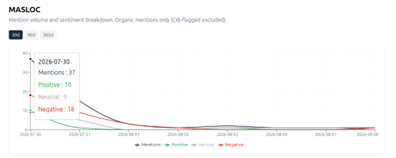
MASLOC experienced a sharp spike in attention on 30 July. Although the surge lasted only two days, sentiment around the discussion was predominantly negative.
The Sedina Tamakloe case generated distinct stream of political discussion during the period.
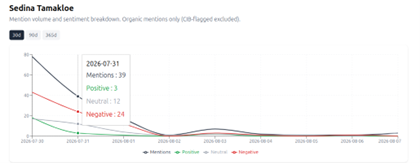
Its significance lies within a wider accountability narrative that repeatedly surfaced throughout July. Public attention remained focused on how state institutions investigate allegations, pursue cases and respond to individuals connected to politically consequential controversies. The conversation around the Ken Ofori-Atta extradition and the Office of the Special Prosecutor also fed into this broader debate.
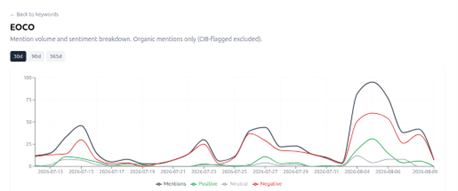
EOCO generated a more sustained presence.
One of the most prominent narratives concerned Dennis Miracles Aboagye, whose arrest, detention and GH¢50 million bail conditions generated substantial engagement, particularly on Facebook.
The controversy also entered Parliament, with Minority Leader Alexander Afenyo-Markin challenging the bail conditions while Majority MP Dafeamekpor disputed his intervention.
What began as a law-enforcement and legal matter quickly acquired a broader political meaning. The case became connected to narratives of political persecution and to the NPP’s mobilisation around Bawumia’s emerging political future.
This illustrates one of the defining characteristics of Ghana’s contemporary digital political environment: institutional events rarely remain institutional for long.
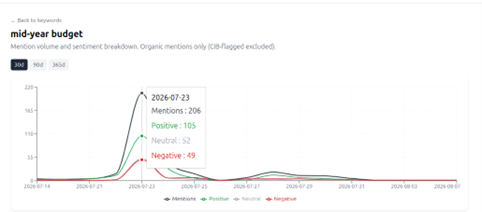
The economy remains prominent. The Mid-Year Budget Review generated positive discussion in the broader issue tracking, while the cedi, GoldBod and macroeconomic performance also featured in the conversation.
Galamsey is another persistent source of negative sentiment. The issue is described in the dataset as a major and continuously recurring topic, with sentiment strongly negative toward the current administration.
Infrastructure also commands attention, particularly among supporters of Mahama, who cite construction activity as evidence of government performance. Yet the conversation frequently remains generic, referring to roads, interchanges and construction pace rather than consistently evaluating named programmes or measurable outcomes.
Jobs and sanitation appear as more immediate service-delivery concerns. Appeals for employment opportunities and demands for better waste management show how everyday governance issues enter the political conversation as tests of government performance.
These themes are significant because they represent moments when the political conversation moves beyond personalities and towards the practical consequences of government.
What the Conversation Reveals
The central finding from this 30-day digital snapshot is not simply that sentiment is negative. It is that political judgement online is increasingly expressed through the language of personality.
The overall substance index of approximately 0.30 means that policy remains present, but it does not dominate. The largest share of conversation concerns individuals, their credibility, their political affiliations, their perceived competence and their relationships with controversial events.
This is particularly consequential because the same event can carry very different meanings depending on the political identity attached to it.
A reduction in the debt-to-GDP ratio becomes a dispute over which political party deserves credit. A prosecution becomes an argument over political victimisation or prosecutorial overreach. Infrastructure becomes a measure of Mahama’s leadership. A past digitalisation claim becomes a test of Bawumia’s credibility.
The conversation is therefore not simply about what government is doing. It is increasingly about what government action says about the people associated with it.
There is also a significant difference in the intensity of engagement across platforms. TikTok contains fewer mentions than Twitter/X but produces exceptionally high engagement around personality-centred content. Twitter/X generates much greater volume, while most individual posts in the monitored sample show relatively limited engagement.
That distinction matters for anyone attempting to understand the digital public sphere. Volume and virality are not necessarily the same thing.
Conclusion
Ghana’s digital political conversation is not short of issues. What it lacks is a sustained separation between the issue and the individual.
Economic management, galamsey, infrastructure, employment, sanitation, environmental restoration, and institutional accountability all generate discussion. Yet much of that discussion is filtered through partisan allegiance and personal assessments of Mahama, Bawumia, and other political actors.
The result is a political conversation in which policy can quickly become personality, institutional action can become partisan grievance, and political performance can become a judgement of character.
Perhaps the most important feature of the July digital conversation is that the online public sphere is not merely recording political debate. It is actively shaping the frames through which political performance is interpreted.


