Ghana’s Parliament on Wednesday, 29th July 2026 signalled a stronger commitment to evidence-based policymaking after convening its maiden Information Sharing Session on Economic Governance and Public Financial Management, bringing together lawmakers, researchers and civil society leaders to examine how data and independent analysis can strengthen fiscal oversight.
Among the panelists was Franklin Cudjoe, Founding President and Chief Executive Officer of IMANI Centre for Policy and Education, who urged Parliament to place greater emphasis on monitoring public expenditure, institutionalising research partnerships and subjecting major public investments to rigorous economic analysis.

Addressing Parliament’s oversight role over the next twelve months, Mr Cudjoe identified the government’s commitment authorisation policy as one of the most consequential fiscal reforms requiring sustained scrutiny.
“I think it is important that we watch that particular policy… if it is done properly, we’ll be saving the country a lot of money.”
He argued that while fiscal correction remains important, oversight must extend beyond expenditure controls to evaluating whether large-scale investments deliver value for money.
Referring to the proposed Accra-Kumasi Expressway project, Mr Cudjoe called for greater transparency before major financial commitments are made.
“We need to see those calculations and then make judgments as to whether we are spending money properly because $4 billion is a lot of money and it can change the economy if you spend it well.”
Throughout the discussion, Mr Cudjoe pointed to IMANI’s policy interventions as examples of how civil society organisations can shape legislation through research rather than advocacy alone.
He cited the organisation’s contributions to Ghana’s proposed Extended Producer Responsibility legislation, reforms around the country’s emerging critical minerals framework, and technical work that informed the establishment of the Fiscal Council.
“We inserted ourselves into the conversation to make sure that the right conversation is being had.”
He said effective policy engagement requires evidence to be introduced early in the legislative process, allowing Parliament to deliberate on facts and international best practices before decisions are taken.
On collaboration between Parliament and research institutions, Mr Cudjoe called for structured partnerships that move beyond occasional workshops and consultations.
Highlighting IMANI’s ongoing policy training programme for parliamentary researchers, he argued that strengthening technical capacity within Parliament would improve legislative oversight and policymaking.
Looking ahead, Mr Cudjoe announced that IMANI is shifting its focus from traditional government scorecards to comprehensive impact assessments of ministries, measuring not only whether policy commitments are fulfilled but also whether public spending produces meaningful outcomes.
He explained that the initiative would engage each ministry to examine inherited challenges, progress made, remaining gaps and the effectiveness of resource allocation.
“What did you come to meet? What have you done about them? What are the significant gaps that exist? And how are you going to close those gaps?”
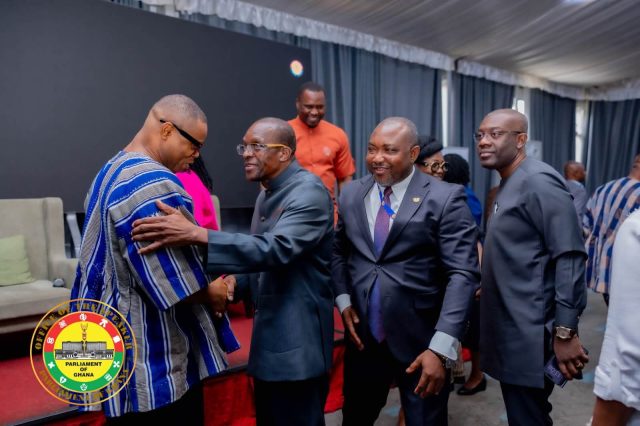
The session concluded with Speaker of Parliament Alban Bagbin endorsing stronger institutional links between Parliament, academia and credible civil society organisations. He noted that Parliament had already begun establishing permanent channels of engagement with research institutions to improve committee work, policy scrutiny and legislative decision-making.
The maiden Information Sharing Session marks the beginning of what Parliament intends to become a sustained platform for integrating independent research into Ghana’s economic governance architecture, reinforcing the role of evidence in shaping public policy and strengthening democratic accountability.