
Accra, Ghana – MTN Ghana has reaffirmed its commitment to driving digital inclusion and sustainable growth across the country, as it engaged civil society organisations (CSOs) in a high-level dialogue on the future of connectivity and access.
The CSO Engagement Forum, held on Wednesday, 10 September 2025, at MTN House in Accra, brought together stakeholders to examine the opportunities and challenges of Ghana’s digital transformation. Under the theme “Connectivity, Access, and Digital Enablers: A Civil Society Dialogue,” the forum highlighted MTN’s Ambition 2025 Strategy, while opening the floor for frank conversations about sustainability, infrastructure, and customer protection.
Presentations
Delivering the opening presentation was Mrs. Adwoa Afriyie Wiafe, Chief Corporate Services and Sustainability Officer, who outlined MTN’s Ambition 2025 Strategy. She began by stressing the company’s core belief that every individual deserves the benefits of a modern, connected life. She explained that MTN recognises the growing responsibility of businesses to contribute meaningfully to society, noting that MTN’s strategic vision seeks to unlock Africa’s potential by leveraging digital connectivity.
Mrs. Wiafe described Ambition 2025 as a blueprint to accelerate growth by building the largest and most valuable platform businesses, while also ensuring industry-leading connectivity. She noted that MTN’s sustainability vision goes beyond traditional environmental, social, and governance practices by seeking to deliver socio-economic value across Africa. This, she added, involves balancing long-term sustainability goals with the immediate needs of employment, poverty reduction, and inclusive growth.
As part of her presentation, Mrs. Wiafe explained MTN’s climate commitments and governance structures. She stated that MTN has set a target of achieving Net Zero greenhouse gas emissions by 2040, which is ten years earlier than the global industry benchmark set by GSMA. In alignment with the Paris Agreement, the company has revised its medium-term targets, aiming for a 50 percent reduction in emissions by 2030, with significant progress already made, including a 13.9 percent reduction in Scope 1 and 2 emissions in 2022. She further noted that climate action is embedded into MTN’s corporate governance, with a designated board member responsible for climate change issues, and that MTN has formally committed to the Taskforce on Climate-Related Financial Disclosures (TCFD) framework to improve transparency and accountability in managing climate-related risks.
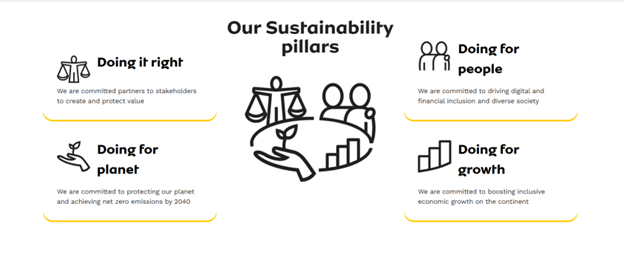
She then walked participants through the four pillars of Ambition 2025. The first, Doing for the Planet, highlights MTN’s eco-responsibility initiatives, including its growing reliance on renewable energy sources such as solar power, with half of its data centres already running on clean energy and plans underway to extend this to regional offices. The second, Doing for People, focuses on enhancing digital inclusion, affordability, and rural connectivity, as well as driving financial inclusion through the MoMo platform. It also prioritises diversity and inclusion, with commitments to achieve gender pay parity and gender balance in leadership by 2030, alongside deliberate efforts to include people with disabilities in the workforce.
The third pillar, Doing it Right, underscores MTN’s responsibility to maintain sound governance practices, uphold human rights, and foster trust through ethical business operations. This includes strict adherence to data privacy, anti-corruption policies, and responsible procurement practices. The fourth pillar, Doing for Growth, emphasises MTN’s contribution to Africa’s economic development through investment in infrastructure, 5G networks, enterprise development, job creation, and tax contributions that support public services.
Mrs. Wiafe concluded her presentation by drawing attention to MTN’s corporate social investment (CSI) strategy, noting that the company has committed at least one percent of its net profit after tax to CSI, with seventy-five percent of that funding directed to ICT ecosystem development. She highlighted youth empowerment, women’s empowerment, and ICT-enabled programmes as priority areas, supported by rigorous partner vetting and monitoring systems to ensure measurable impact.
The second presentation was delivered by Mr. Reuben Opata, who is the Chief Technical Officer. He provided an overview of MTN’s network infrastructure and the challenges facing connectivity expansion. He pointed out that one of the biggest obstacles is the frequent cutting of fibre optic cables, which not only disrupts service delivery but also results in significant repair costs (GHS 22,794,061) this year alone. He added that in some rural communities, MTN faces difficulties acquiring land for infrastructure projects due to superstition or health-related misconceptions, limiting the company’s ability to provide reliable service in those areas. With respect to fibre connectivity in Accra, he explained that some communities remain underserved because they are still in developmental stages, making it economically unfeasible to install fibre at present. As an interim measure, MTN offers alternative solutions, such as routers to provide connectivity in these areas.
The final session focused on MTN’s Mobile Money (MoMo) service, which was led by Abdul-Majeed Rufai, who focused on fraud prevention. Stakeholders raised concerns about persistent fraud attempts on the platform, to which MTN responded by outlining its enhanced countermeasures. These include the deployment of artificial intelligence systems capable of intercepting and blocking fraudulent messages before they reach customers, restrictions on the forwarding of MoMo messages, and extensive public education campaigns. Notably, MTN has been conducting community outreach activities in rural areas, using stage plays and local language education to sensitise residents about fraud risks. The company also reinforced its message on the importance of safeguarding personal security details such as MoMo PINs and one-time passwords (OTPs).
In conclusion, the CSO Engagement Forum offered valuable insights into MTN’s corporate strategy, operational challenges, and stakeholder engagement priorities. The Ambition 2025 framework clearly demonstrates MTN’s ambition to lead in digital solutions while balancing sustainability, inclusion, and growth objectives. The discussions on infrastructure challenges and MoMo fraud prevention reflected MTN’s willingness to acknowledge stakeholder concerns and to collaborate on solutions.
By: David Kukuia-Galley, Multimedia Administrator


