
On 15th September 2025, the Open Society Foundations (OSF), in partnership with the International Development Economics Associates-Africa Network (IDAN), convened a high-level public event in Accra at the University of Ghana’s Cedi Conference Centre to mark the International Day of Democracy.
The event centered on the launch of OSF’s commissioned study, “Analysis of the Nexus between Democratic Governance and Economic Justice in Africa”, authored by Dr. Ndongo Samba Sylla. It brought together policymakers, constitutional scholars, economists, civil society actors, academics, media, and youth voices to interrogate one of Africa’s most enduring dilemmas: how to reconcile democracy and development in a way that delivers economic justice and dignity for all.
The discussions were anchored by a keynote address by Professor H. Kwesi Prempeh, Executive Director of CDD-Ghana and Chair of Ghana’s Constitutional Review Committee, and by a presentation of the study findings by Dr. Sylla, Director for Research and Policy at IDEAS–Africa Network.
Recent debates in Africa have often portrayed democracy and development as mutually exclusive. Authoritarian models are sometimes glorified, with China or the Arab Gulf states held up as proof that development can be achieved without democracy. Conversely, democratic regimes on the continent face growing dissatisfaction, as revealed by Afrobarometer’s 2024 survey: while support for democracy remains relatively high, confidence in its outcomes has fallen sharply.
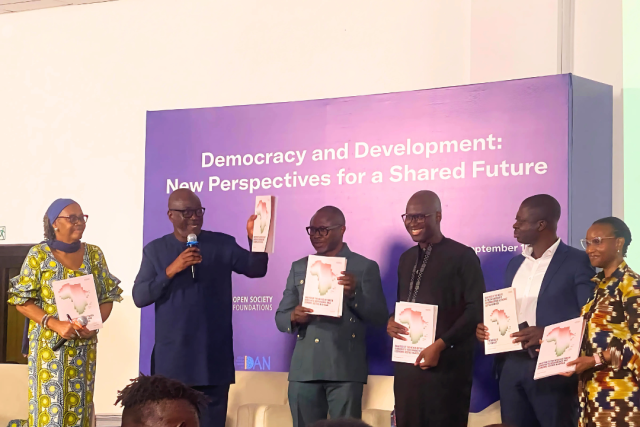
Keynote Address: Professor H. Kwesi Prempeh, Executive Director of CDD-Ghana and Chair of Ghana’s Constitutional Review Committee
Professor Prempeh’s keynote set the tone by interrogating the false dichotomy of “democracy vs. development.” He observed that:
- For decades, democracy in Africa has been forced to “prove its worth” by delivering development outcomes, while authoritarianism, despite repeated failures, was rarely held to the same standard.
- The prevailing model of African democracy is overly fixated on elections (rules of entry and exit), without reforming the rules of play; the distribution and exercise of power once leaders assume office.
- This has created democracies that often reproduce authoritarian tendencies, where citizens vote but remain largely excluded from real decision-making.
Prof. Prempeh was blunt: Ghana and other African democracies risk becoming “governments of politicians, by politicians, for politicians”, where public interest is sidelined in favor of elite bargains.
He called for a “second generation of constitutional reforms” that move from a “political constitution” to a “developmental constitution.” Such a framework, he argued, must:
- Decentralize power and resources to communities.
- Reform campaign and political party financing to break the stranglehold of money on politics.
- Open new, institutionalized avenues for citizen participation beyond periodic elections.
- Safeguard the neutrality and professionalism of the public service from partisan capture.
His most compelling call was to transform Africans from “periodic voters into regular stakeholders” in governance, shifting democracy from a ritual of elections to a daily practice of participation.
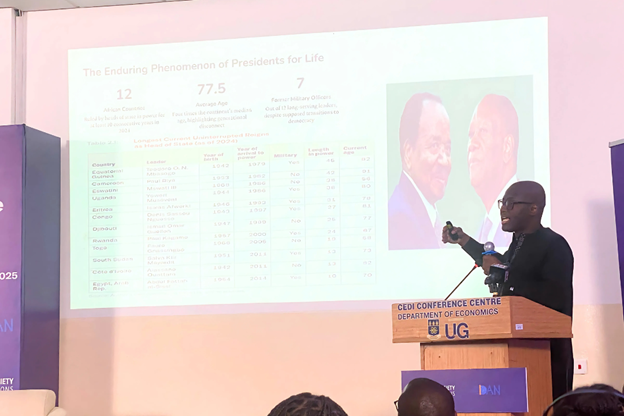
Presentation of Study Findings: Dr. Ndongo Samba Sylla, Director for Research and Policy at IDEAS–Africa Network
Dr. Sylla’s presentation of the study provided a rigorous intellectual anchor for the discussions. The almost 100-page report explores the complex relationship between democracy and economic justice across Africa, tracing historical legacies, neoliberal economic constraints, and contemporary challenges.
Main Arguments
- Democracy must be substantive, not formal.
Liberal democracy, as practiced in much of Africa, has become “choiceless”, citizens may vote, but elected governments are constrained by neoliberal economic frameworks and external dependence. - Economic justice is central to democratic legitimacy.
True democracy requires fair distribution of resources, opportunities, and social protections. Without this, support for democracy erodes, as Afrobarometer surveys show. - Coups are symptoms of systemic failure, not anomalies.
The recent wave of military takeovers reflects both neo-colonial entanglements (especially in former French colonies) and the frustrations of “choiceless democracies” that fail to deliver economic justice. - Africa must innovate democratic forms.
Instead of mimicking Euro-American models, African societies can draw on rich traditions of consensus, accountability, and communal governance to create new democratic institutions fit for purpose.
Policy Recommendations
The report makes concrete proposals, including:
- Universal public services in health, education, and employment guarantees.
- Campaign finance reforms to curb money politics and expand inclusion for women and youth.
- Rethinking electoral systems, including proportional representation and sortition (citizens selected by lot) to broaden representation.
- Decentralized resource governance to ensure local communities benefit directly from natural wealth.
- Civic education on finance and democracy to empower citizens to hold leaders accountable.
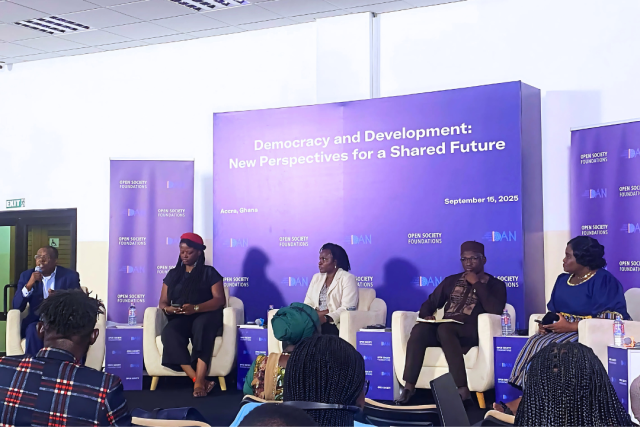
Panel Discussions
The panel discussions provided a vibrant platform where diverse voices expanded on the keynote and study findings, bringing fresh perspectives on democracy, development, and economic justice. Speakers highlighted broad themes: neo-colonial constraints, socio-economic equality in democracy, and the financialization of politics and inclusive democracy.
Neo-colonial Structures and Debt Dependency
Several speakers emphasized the enduring legacies of neo-colonialism in shaping Africa’s governance and economic trajectories.
- Dr. Liliane Umubyeyi (African Future Labs) drew attention to the inequities of global climate agreements, arguing that Africa, despite contributing least to global carbon emissions, finds itself burdened with unsustainable debt through so-called “green deals.” She called for an end to “green colonization” and urged African states to design frameworks that place their interests first.
- Willis Evans Otieno (Otieno Ogola Advocates) focused on the debt crisis, describing Africa’s growing debt burden as a tool of continued domination. He urged African governments to consider halting repayment of illegitimate “legacy debts” that have little developmental impact and called for accountability for leaders and external partners who facilitated reckless borrowing. He also stressed the importance of educating the legislative arm of government and citizens, especially the youth on the economic and political consequences of these debts as part of a broader movement for resource sovereignty.
- Dr. Amzat Boukari-Yabara (Historian) underscored the importance of early education in democratic values, urging Africa to emulate Europe in building strong institutional frameworks that link economic democracy with development and security. For him, empowering youth and embedding democratic consciousness from childhood are critical for Africa’s long-term resilience.
- Building on the economic dimension, Dr. Ndongo Samba Sylla reminded participants that raising taxes will not resolve Africa’s debt problems, since taxation itself is embedded in colonial financial systems. Instead, he proposed strengthening central banks to play a more developmental role: scrutinizing national budgets, ensuring transparency, and using public banking channels to mobilize resources for genuine development.
The Centrality of Socio-economic Development and Equality in the Pro-democracy Struggle
Panelists also addressed the structural inequalities that weaken Africa’s democratic project.
- Namata Serumaga-Musisi (Economic Freedom Fighters League, Ghana) highlighted the disconnect between imported democratic systems and African realities, where political elites (Minority) control institutions without meaningful engagement with citizens (Majority). She called for a more wholesome and inclusive approach to democracy that ensures power is shared, not monopolized.
- Dr. Dede Bedu-Addo (Independent Consultant on Gender and Social Development) drew attention to persistent gender and disability disparities in democratic participation. She emphasized the need for intentional strategies to engage marginalized groups, insisting that “we are all involved.” She also encouraged citizens to ask difficult questions and not remain silent in the face of exclusion.
Financialization of Politics and the Future of Inclusive Democracies
This theme explored how money distorts democracy and how inclusive financing models could bridge the gap.
- Samson Itodo (YIAGA Africa) spoke passionately about the financial barriers that prevent young people from entering politics. He proposed innovative mechanisms for citizen-funded politics, where ordinary citizens pool resources to support youth candidates who share their values. Such a system, he argued, would not only democratize access but also create a natural accountability loop; citizens who fund campaigns can hold leaders responsible for delivering on promises. He further called for networks of solidarity and mentorship to sustain young leaders in politics beyond election cycles.
Conclusion
The launch of Dr. Sylla’s study marked an important milestone in rethinking Africa’s democratic journey. As Professor Prempeh reminded the gathering, democracy in Africa cannot rest on elections alone; it must become a developmental project that answers the aspirations of its people.
The study equips policymakers, civil society, and citizens with a roadmap to bridge democracy and economic justice. It insists that democracy, far from being a luxury, is the only sustainable path to inclusive development, provided it is recalibrated to empower citizens, redistribute resources fairly, and dismantle structural inequalities.
The Accra dialogue closed with a shared sense of urgency: Africa’s democratic project is at a crossroads, but it is also rich with possibility. With courageous reforms, citizen mobilization, and institutional innovation, the continent can move from “choiceless democracy” to substantive democracy that delivers dignity, justice, and development for all.
Report by: David Kukuia-Galley


